24-Hour Electrician in Singapore: What to Expect
When the power goes at 11pm, knowing how after-hours electrician services work helps you make good calls under pressure. Here is the process, the pricing, and how to prepare.
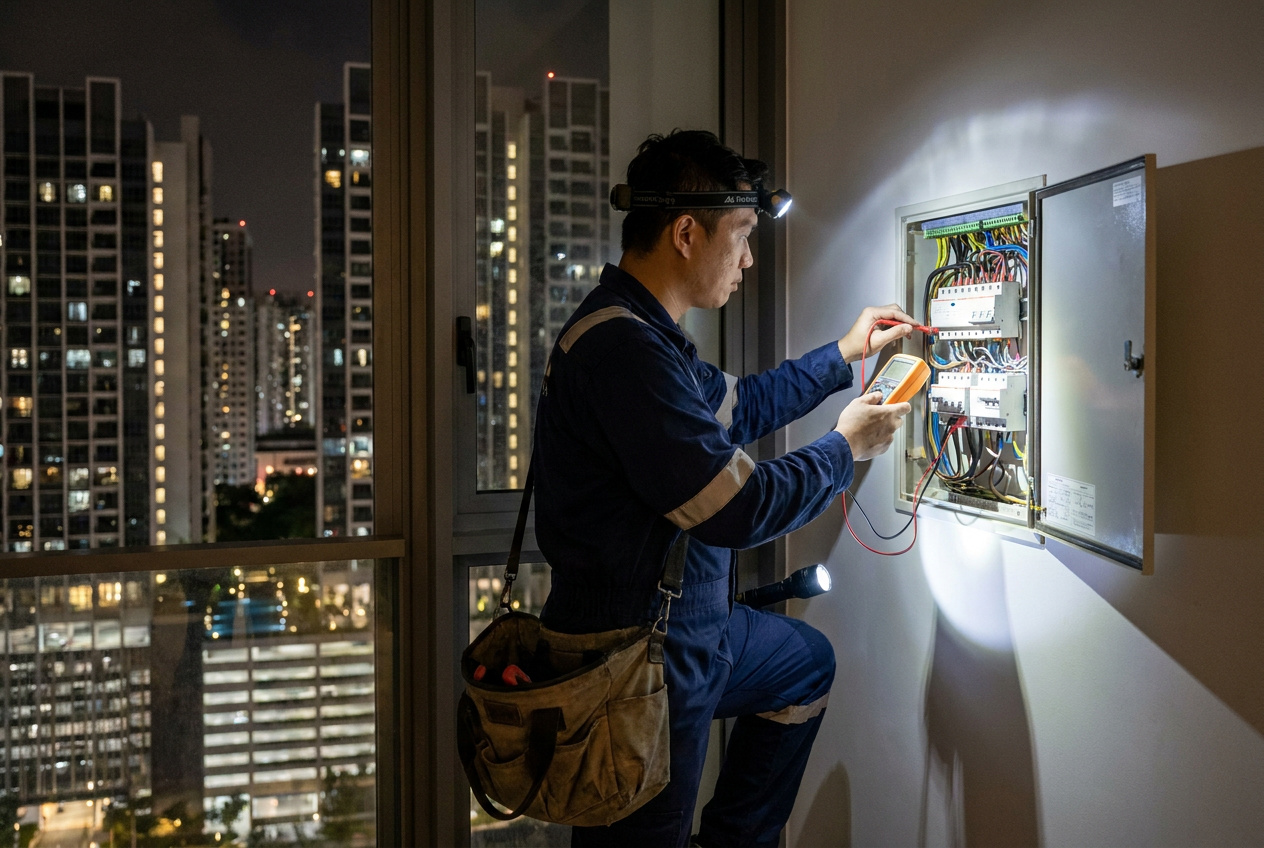
It is 11pm. Your flat has gone completely dark. Your neighbours still have lights, so it is not an area-wide outage. The aircon has stopped, the fridge is warming up, and your phone is at 12 per cent.
Electrical problems do not keep office hours. When something fails at night or over a weekend, knowing how after-hours electrician services work in Singapore helps you decide well under pressure.
How 24-hour services actually work
Most 24-hour electrician services here run on an on-call model rather than keeping electricians sitting and waiting all night. The usual process looks like this.
- You call the line. A duty coordinator or the on-call electrician picks up and asks what happened, what you have already tried, and whether there are safety concerns like a burning smell or sparking.
- They judge the urgency. A genuine emergency is dispatched immediately. Something that can safely wait a few hours may be booked for the first morning slot, which saves you the after-hours surcharge.
- The nearest available electrician is sent out. In Singapore, most providers reach you within 30 to 90 minutes depending on the time, traffic, and where you are on the island.
- On arrival we diagnose the fault and either fix it on the spot or make it safe until a full repair during normal hours. We carry common parts like MCBs, RCCBs, cable, and basic fittings, but specialised components may need sourcing in business hours.
- Payment is usually taken on-site once the work is done. Some providers accept card; others want cash for after-hours calls.
Common after-hours problems
Certain faults show up more often in the evening and at night, usually because that is when home electrical load is highest.
- Complete power loss. When the whole flat goes dark, it is usually the main switch or RCCB that has tripped. The cause might be a faulty appliance, a wiring fault, or moisture-related earth leakage. If resetting does not restore power, or it trips again at once, you need a professional.
- Repeated tripping. A breaker that trips once can often be reset. One that keeps tripping has an underlying fault that needs diagnosing. It often happens in the evening when the kitchen circuit is loaded with cooking appliances.
- Burning smell from a socket or switch. Always urgent, whatever the time. It means overheating that can lead to fire. Switch off the affected circuit at the DB box (or the main switch if you cannot identify it) and call for help.
- Post-storm faults. After heavy rain or thunderstorms, moisture and lightning-related surges can cause faults, often in the evening during monsoon season, affecting the RCCB or individual circuits.
- Water heater failure. Not always an emergency, but losing hot water at night is no fun. If the heater has tripped its circuit or the unit has failed, we can tell whether it is an electrical fault or a heater replacement.
What a night call looks like
Knowing what happens during an after-hours visit sets realistic expectations.
- Diagnosis first, then options. We assess before doing any work, then explain what we found, what is needed, and what it costs before going ahead. If the job is large, we may make it safe tonight and book the full repair for the next day.
- Limited parts. We carry common components, but not every specific part. If a particular MCB model, RCCB rating, or replacement is needed, it may have to be sourced in business hours. Where it is safe, we fit a temporary workaround.
- Upfront pricing. A reputable provider explains the after-hours rate structure before starting. Ask about call-out fees, labour rates, and parts costs first. If the price is not clear before work begins, that is a red flag.
- Testing afterwards. Even at night, we test once the repair is done: checking the breakers hold under load, verifying RCCB trip times, and confirming the fix is stable before we leave.
Pricing for after-hours work
After-hours work costs more than standard daytime rates. Understanding the structure helps you budget and weigh up quotes.
- Call-out fee. Most providers charge a fixed fee for after-hours visits. On current Singapore market rates this is typically S$100 to S$300, with late-night calls (after 10pm) usually at the upper end, S$150 to S$300. It covers travel and mobilisation, and some providers waive it when substantial work is done.
- Labour surcharge. On top of standard hourly rates, expect 30 to 100 per cent more for after-hours work. Late-night and public holiday calls carry the highest surcharges.
- Parts at cost. Replacement parts should be charged at a fair market rate, not inflated for the timing. If a provider is marking parts up heavily for a night call, question it.
Typical scenarios and indicative costs
These figures are a guide only and vary by provider, scope, and time of day. Always confirm before work begins.
- RCCB reset and diagnosis: S$120 to S$200.
- MCB replacement: S$150 to S$250, parts included.
- Fault diagnosis and temporary isolation: S$150 to S$300.
- Emergency rewiring of a damaged section: depends on the extent and the cable runs involved. We assess and give you a price before we start.
How to prepare for the visit
A few quick steps before we arrive make the visit faster and smoother.
- Know where your DB box is. Most HDB flats have it near the front door; condos vary. We will need access the moment we arrive.
- Note what happened. Write down what you were doing, which appliances were running, whether you heard a pop or smelled anything, and whether the whole flat or just one area lost power.
- Switch off the affected area. If one circuit is tripping, switch off its MCB. If there is a burning smell, switch off the main switch. This stops things getting worse while you wait.
- Clear access. Move anything blocking the DB box or the problem area so we can work quickly and safely.
- Have your address ready. Give block and unit numbers and any access details (gate codes, lift cards). For condos, check after-hours access rules for contractors.
- Prepare payment. Have cash as a backup even if card is accepted, and ask about payment methods when you call.
Are 24-hour electricians more expensive than daytime?
Yes. After-hours work usually costs more. The surcharge varies, but expect 30 to 100 per cent more for work outside standard office hours, with late-night calls (after 10pm) and public holiday calls at the top end.
The higher cost reflects real factors: electricians answering after-hours calls give up personal time, and mobilising at short notice off-peak takes more logistics. Some charge a flat call-out fee (commonly S$100 to S$300, late-night calls toward the S$150 to S$300 end) on top of standard rates; others apply a percentage surcharge. When you call, ask about the pricing structure. A reputable provider explains rates before dispatching. The real question is whether the issue needs attention now or can safely wait until morning.
How quickly can a night-time electrician arrive?
Response times usually fall in the 30 to 90 minute range, depending on dispatch capacity, the time of the call, and your location. Between midnight and 6am they may run a little longer, as fewer electricians are on active standby.
Singapore's compact size works in your favour. Travel across the island often stays under 45 minutes off-peak, and late at night the roads tend to be clear, though times vary with traffic. Some providers offer guaranteed windows. Being clear about how urgent your situation is helps them prioritise. While you wait, focus on safety: switch off the main power if there is a burning smell, and stay clear of flooded areas near electrical equipment.
What issues warrant calling at night?
Call right away for a burning smell from any socket, switch, or DB box. A full power loss while neighbours still have power needs professional diagnosis. Sparking or arcing from sockets or wiring is a fire risk. Exposed live wires and water reaching your electrics both need immediate attention.
Issues that can usually wait include a single tripped circuit you can isolate by switching off its MCB, power points dead in one room while the rest works, and flickering in one light fitting, which usually points to a loose connection rather than a wider problem. The general rule: if there is fire or shock risk, or the situation is getting worse, call now. If it is contained and stable, it can wait.
Can I wait until morning for non-emergency issues?
Often, yes. If a single circuit has tripped, switch off its MCB to isolate it. You lose that circuit but the rest of your home keeps working. Removing a faulty appliance and resetting the MCB often clears the immediate problem.
Do not wait, though, if the same MCB trips repeatedly after resetting, if you notice warmth, discolouration, or a smell around the DB box, or if your RCCB will not reset, which leaves your flat without earth leakage protection. When in doubt, a quick call helps you judge whether it needs attention now.
Do 24-hour electricians carry the same licences?
Yes. A Licensed Electrical Worker holds the same licence whatever the hour. There is no separate night-time or emergency licence. The electrician should hold the LEW grade the work requires, and the same safety standards and testing apply.
The only practical difference is that complex work may get a temporary fix at night and a full repair by day, which is both sensible and often more cost-effective. Always ask for LEW details when the electrician arrives.
Help when you need it
An electrical emergency is stressful enough without wondering what the service will involve. Now you know how after-hours calls work, what they cost, and how to prepare. The key takeaway is judging which situations need attention now and which can safely wait.
When it calls for it, our 24-hour emergency electrician service covers all of Singapore. For non-urgent jobs, booking a daytime troubleshooting appointment is the more cost-effective route.