Circuit Breaker Tripping: Causes, Fixes, and When to Worry
That sudden click and a dark room is your breaker doing its job. Here is why breakers trip, how to respond safely, and when to call a professional.
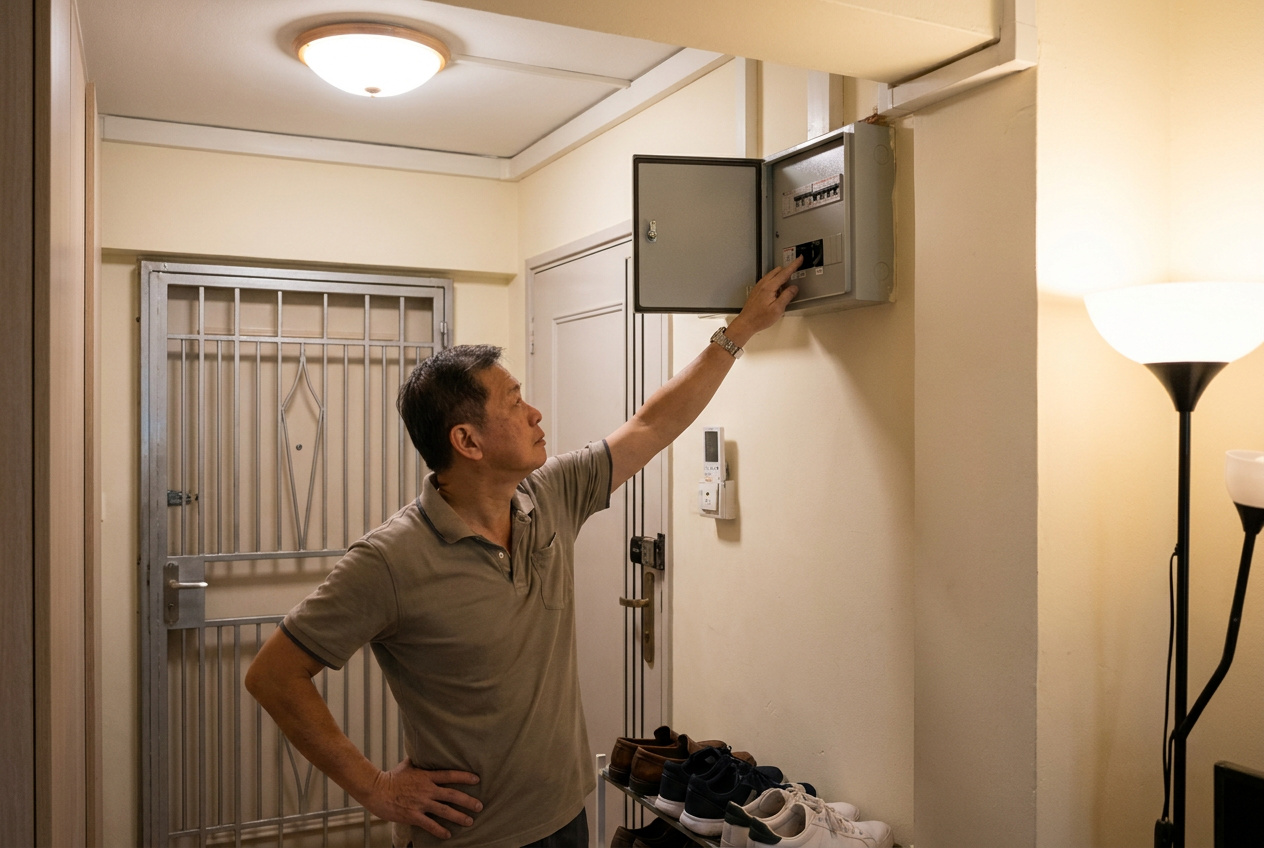
A tripping circuit breaker is one of the most common electrical problems in Singapore homes. That sharp click, then part of your flat going dark, is your system doing exactly what it was built to do: cutting power before something worse can happen.
Once you understand why breakers trip, how to react safely, and when the issue needs a professional, you save yourself a lot of stress and keep your home safe.
Common causes of circuit breaker tripping
- Overloaded circuits: the most frequent cause. When the total draw on a circuit goes past the breaker's rating, it trips. In older HDB flats one circuit often feeds a whole room of sockets, so running an air conditioner, a heater, and an iron together can push it over the edge.
- Short circuits: a live wire touches a neutral wire and creates a sudden current surge. It can happen inside an appliance, in a wall, or at a damaged cord. The breaker trips instantly, and it may feel warm when you check it.
- Ground faults and earth leakage: when current finds an unintended path to earth, often through water, a person, or damaged insulation, the RCCB or ELCB senses it and trips. Common in kitchens and bathrooms where moisture is around.
- Faulty breaker: breakers do not last forever. After years of use the internal mechanism can wear out, tripping at loads well below the rating or at random.
- Arc faults in older wiring: in flats with ageing wiring, damaged insulation can cause arcing, small sparks jumping across gaps. That makes heat and can eventually trip the breaker or, if ignored, start a fire.
Types of circuit breakers in Singapore homes
Your DB box holds different kinds of breakers, and knowing which one tripped helps you work out the problem.
- MCB (Miniature Circuit Breaker): protects one circuit from overcurrent. Each is rated for a set amperage (6A, 10A, 16A, 20A, or 32A). When it trips, only that circuit loses power.
- RCCB or ELCB: protects against earth leakage. When it trips, it usually cuts power to every circuit downstream. If your whole flat goes dark but the neighbours are fine, the RCCB has likely tripped.
- Main switch: controls the entire supply to your flat. It rarely trips on its own, but if it does, the trouble is probably at the supply level or there is a major fault.
How to identify which breaker tripped
Open your DB box and look at the toggles. A tripped breaker sits in the middle position (not fully on, not fully off) or in the off position. Some have a small window that shows red when tripped.
If your circuits are labelled (and they should be), the label tells you which area is affected. If not, this is a good moment to map them: switch each MCB on and off and note which sockets and lights respond.
Safe DIY troubleshooting steps
Before you call an electrician, there are a few safe steps you can take.
- Step 1: switch off every appliance on the affected circuit and unplug anything connected to its sockets.
- Step 2: reset the breaker by pushing the toggle firmly to off first, then back to on. Some need a firm push.
- Step 3: if it holds, reconnect appliances one at a time, waiting a few minutes between each. If it trips when you plug in a particular appliance, that appliance is likely the cause.
- Step 4: if it trips right after reset with nothing plugged in, the fault is in the wiring or the breaker itself. Do not keep resetting it; this needs a professional.
- Step 5: for RCCB trips, the process is similar, but check all circuits, not just one. An earth leakage fault can sit on any circuit the RCCB covers.
When to call a licensed electrician
Some situations go beyond safe DIY. Call an electrician if:
- The breaker trips immediately after reset with nothing plugged in.
- You smell burning near the DB box or any outlet.
- You see scorch marks, discolouration, or melted plastic.
- The same breaker trips again and again even after you remove suspected faulty appliances.
- You feel a tingle when touching an appliance or a metal surface.
- Your RCCB trips often with no obvious cause.
- The breaker toggle feels loose, will not click firmly, or the breaker feels warm.
Why these signs matter
These can point to wiring faults, failing insulation, or worn components that need a proper diagnosis and repair. A Licensed Electrical Worker has the tools and training to safely check inside your DB box and wiring, including insulation resistance testing and thermal imaging. Our HDB residential LEW service makes sure all work meets EMA regulations.
What causes a circuit breaker to keep tripping repeatedly?
A breaker that keeps tripping is reacting to an ongoing problem on that circuit. The most frequent reason is overload, where the combined draw of connected appliances passes the breaker's rating. This is common in older HDB flats where a single 16A circuit feeds several sockets.
A short circuit is another common cause, often from damaged insulation letting live and neutral touch, which trips the breaker instantly. Faulty appliances are a third: one with worn internal wiring or a failing motor can draw irregular current and trip the breaker.
To pin it down, unplug everything on the circuit, reset the breaker, then reconnect items one at a time. If it trips when a specific appliance goes in, you have found it. Less often, the breaker itself is worn out, since MCBs have a limited number of operations before the trip mechanism becomes unreliable.
How do I replace a faulty circuit breaker in Singapore?
Replacing a breaker is not a DIY job. Under the Electricity Act, any work on your distribution board, including swapping an MCB, RCCB, or ELCB, must be done by a Licensed Electrical Worker (LEW). The work involves live connections and the risk of shock or fire if done wrong.
Get a licensed electrician to assess the situation, confirm the breaker is actually faulty (and not simply reacting to a real fault), and fit a correctly rated unit. They then test the new breaker and the circuit.
A single MCB replacement is modest, usually S$80 to S$150 including part and labour. RCCB replacement costs more, around S$150 to S$300 as a guide, varying with brand, rating, and complexity. If your DB box is old and several breakers need work, your electrician may suggest replacing the whole board instead.
What is the difference between MCB and RCCB?
An MCB and an RCCB do different jobs in your DB box. An MCB protects against overcurrent, tripping when the current through a circuit goes past its rating (say 16A or 20A). That stops wires from overheating. Each MCB covers one circuit.
An RCCB protects against earth leakage, tripping when current takes an unintended path, such as through a person who touches a live wire or through water. It compares the current out on the live wire with the current back on the neutral. A difference of even 30 milliamps means leakage, and it trips within milliseconds.
Your DB box needs both. The MCBs guard your wiring against overload and short circuits, while the RCCB guards people against shock. A typical HDB DB box has one or two RCCBs covering all circuits, plus individual MCBs for each circuit.
How often should circuit breakers be replaced?
There is no fixed schedule, but breakers do not last forever. MCB service life varies by maker and conditions, with industry estimates usually in the 10 to 30 year range, depending on how often it trips, the load, and the environment. In Singapore's humidity, corrosion can reach the internal contacts sooner than in drier places.
RCCBs should be tested monthly with the test button. If it fails to trip when pressed, replace it right away, whatever its age. As a guide, have your breakers inspected every 5 to 10 years, or sooner if a breaker trips well below its rating, feels warm, shows discolouration, or the toggle feels loose.
A renovation is a practical time to have all breakers checked, since the DB box is already open. Replacing ageing breakers ahead of time is far cheaper and less disruptive than dealing with a failure at a bad moment.
Can a faulty circuit breaker cause a fire?
Yes, though the path is not always obvious. A breaker that fails to trip when it should lets too much current run through the circuit. That overheats the wiring past its safe temperature, which can eventually ignite nearby insulation, timber, or dust.
The risk is highest when a breaker has a worn or damaged trip mechanism that responds too slowly or not at all. Loose connections at the breaker's terminals are another fire risk, since they create resistance that heats up the connection point and, over time, can scorch the DB box.
Warning signs include a burning smell near the DB box, discolouration of the breaker or nearby plastic, a breaker that feels unusually warm, or scorch marks on the enclosure. If you see any of these, switch off the main power and call an emergency electrician. Do not use the affected circuit until it has been inspected and resolved.
What size circuit breaker do I need for my HDB flat?
The amperage of each breaker depends on the circuit it protects and the appliances on it. The main switch rating varies: older flats often have a lower main-switch rating, while newer or upgraded blocks have higher loading, so check your own DB box or ask your LEW. Larger landed homes and condos may have 63A or higher. For individual circuits, common ratings are lighting at 6A or 10A, general power sockets at 16A or 20A, air conditioning at 20A, water heaters at 20A or 32A, and kitchen appliances at 20A or 32A.
The MCB rating must match the wiring it protects. An oversized MCB (say a 32A breaker on cable rated for 20A) is dangerous, because it will not trip before the wiring overheats. An undersized one causes nuisance tripping.
A Licensed Electrical Worker sets the right sizes during installation or replacement by calculating the expected load and matching it to the cable rating. If you are unsure your breakers suit your current usage, a professional check can flag any mismatch, which matters most after renovations that changed how circuits are used.
How much does circuit breaker replacement cost in Singapore?
It depends on the type of breaker and any extra work. A single MCB replacement is usually S$80 to S$150, covering the breaker, labour, and basic testing. RCCB replacement is more, with a guide range of S$150 to S$300, varying with brand, rating, and complexity.
If the electrician finds the problem goes past one breaker, such as loose busbar connections, corroded terminals, or wiring that needs attention, the cost rises. A full DB box replacement, with all new MCBs and an RCCB, is often quoted at S$350 to S$800 for standard 3-room and 4-room HDB flats, with larger flats, condos, and landed homes at the upper end or higher.
Some electricians charge a diagnostic or call-out fee (commonly around S$50 to S$100, varying by provider) on top of the replacement, while others include it. Ask upfront. After-hours or emergency call-outs usually add 50 to 100 per cent on standard rates. Always ask for an itemised quote and confirm the electrician is a Licensed Electrical Worker before any work on your DB box.
Protecting your home's electrical system
Spread high-power appliances across different circuits to avoid overload. Test your RCCB monthly. If you live in an older flat, consider a professional inspection of your DB box and wiring.
When tripping turns frequent or comes with warning signs like burning smells, scorching, or tingling, act quickly. The cost of a professional diagnosis is small next to the risk of letting an electrical fault grow. For reliable diagnosis and repair, reach out about our electrical troubleshooting service or our HDB ELCB service for earth leakage protection upgrades.