Commercial Electrician Services in Singapore: What Businesses Need
Commercial electrical works differently from home: three-phase supply, the 45kVA licensing threshold, fire safety integration, and business continuity. Here is what your premises need.
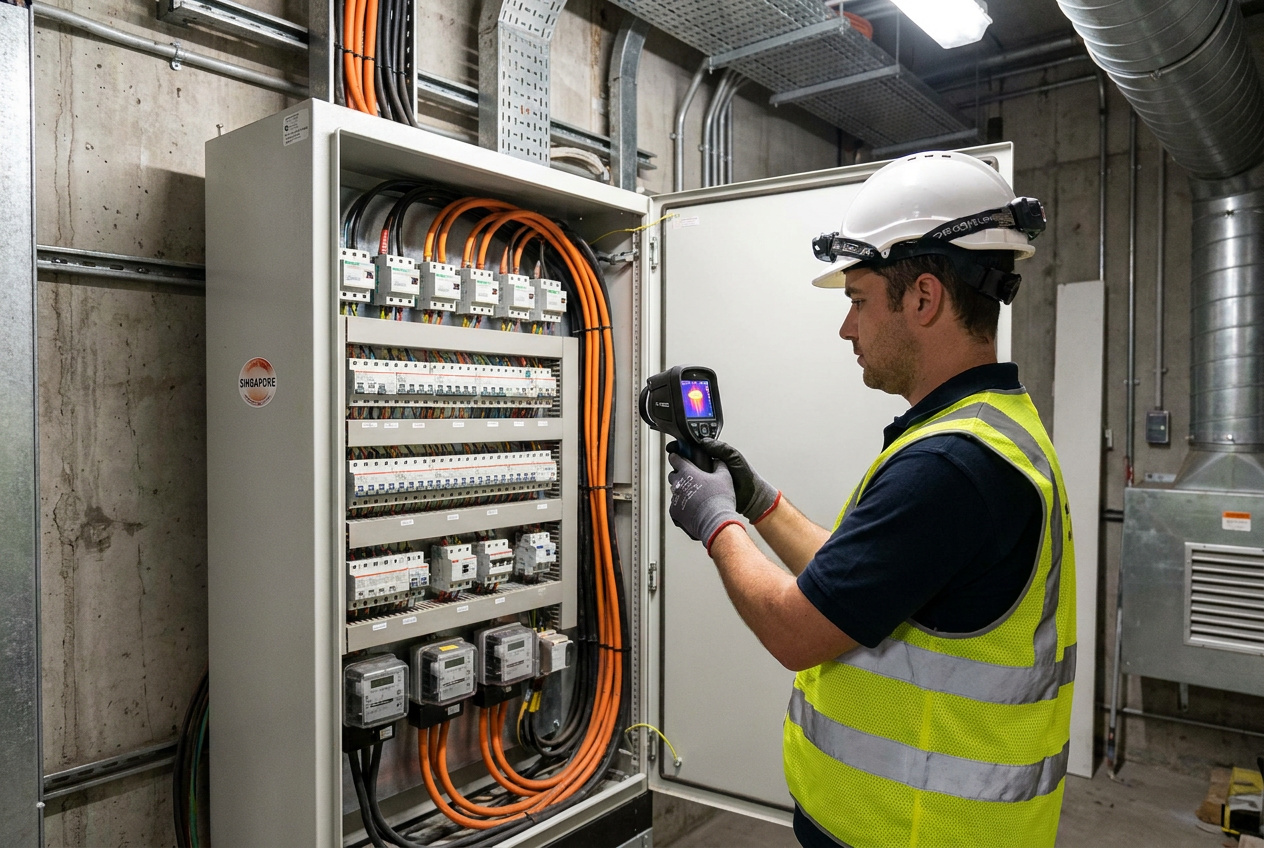
Running a business in Singapore means your electrical system works differently from your home. Higher power demands, three-phase supply, fire safety integration, and compliance requirements all set commercial electrical apart. Whether you operate from an office, a retail unit, a restaurant, or an industrial space, understanding your electrical needs keeps you running and compliant.
How commercial electrical differs from residential
The gap between residential and commercial electrical is wider than most business owners realise.
Power capacity. A typical 4-room HDB flat runs on 40A to 60A single-phase. A medium office might have 100A three-phase. A restaurant or industrial unit can draw far more. Higher capacity means more complex distribution, larger cables, and stricter regulatory oversight.
Three-phase supply. Most commercial premises run on three-phase power, spreading the load across three separate circuits. This is more efficient for high-power equipment like industrial machinery, large air conditioning, and commercial kitchen appliances. Residential electricians who work mainly with single-phase may not have deep experience with three-phase load balancing.
Regulatory classification. Non-domestic installations with power demand above 45kVA are classified as licensed electrical installations under EMA regulations, which captures most commercial premises. Licensed installations require an electrical installation licence, undergo periodic mandatory inspections, and must meet specific EMA conditions. Installations below the 45kVA threshold, typically smaller domestic premises, do not carry these extra requirements.
Fire safety integration. Commercial systems often tie into the building's fire safety infrastructure: emergency lighting, fire alarm power, smoke detector circuits, and emergency power-off systems. These add complexity and need coordination with fire safety consultants.
Business continuity. A residential outage is an inconvenience. A commercial outage costs money, can affect customers, and may damage inventory or equipment. Commercial maintenance is about preventing disruption, not just maintaining safety.
Common commercial electrical services
Commercial needs span the full life of a business, from fit-out through ongoing maintenance.
Office fit-out electrical. Setting up a new office is more than lighting and power points. A proper fit-out plans power distribution for workstations, server rooms, and common areas. Structured cabling for IT and telecoms runs alongside the electrical wiring. Lighting design balances efficiency with comfort. Dedicated circuits handle high-power equipment like photocopiers, server racks, and kitchen appliances. Emergency lighting and exit signs connect to the fire safety system. Getting the layout right at fit-out avoids costly changes later when the team grows or the layout shifts.
Retail and F&B electrical. Retail and food-and-beverage premises have their own demands. Point-of-sale systems, display lighting, signage power, and security all need dedicated circuits. F&B adds commercial kitchen equipment, exhaust systems, walk-in chillers, and high-power cooking appliances. F&B environments are especially demanding, since heat, moisture, and grease stress connections and insulation. Regular maintenance is not optional here; it is essential for safety and reliability.
Industrial and factory electrical. Industrial work covers power distribution for machinery, motor control centres, production line wiring, and heavy-duty lighting. Industrial premises often have medium-voltage supply requiring Electrical Engineer grade LEW oversight. Safety considerations include proper isolation procedures for machinery maintenance, earth fault protection for three-phase motors, and compliance with workplace safety rules that go beyond standard electrical requirements.
LEW requirements for commercial properties
Commercial work requires specific LEW grades that reflect the complexity and risk involved.
For most commercial premises (offices, retail, F&B), an Electrical Technician grade LEW is the minimum. This grade covers low-voltage installations up to 1kV, with an approved-load cap of 500kVA and a design-submission cap of 150kVA, which captures the majority of commercial properties in Singapore.
For industrial premises, shopping centres, or any property with medium-voltage equipment (transformers, 6.6kV or 22kV switchgear), an Electrical Engineer grade LEW is required. This licence is issued with voltage-class sub-grades (22kV, 66kV, 230kV, and 400kV), and the assigned LEW must hold a voltage class covering the installation's intake voltage.
The LEW is personally responsible for certifying that the installation is safe and compliant. For commercial installations, that certification is not just good practice; it is a regulatory requirement. Our commercial and industrial LEW services make sure your premises meet all licensing and compliance requirements.
Do not assume any electrician can work on commercial systems. Ask for the specific LEW grade and confirm it covers your installation. For a full breakdown of grades, see the guide on certified vs licensed electricians in Singapore.
Preventive maintenance for businesses
Proactive maintenance prevents the failures that disrupt operations.
Quarterly visual inspections cover all distribution boards, checking for overheating, loose connections, or physical damage. The electrician confirms all protection devices are in good condition and the system is clean and unobstructed.
Annual comprehensive testing involves insulation resistance testing on all circuits, earth continuity verification, RCD and MCB trip testing, thermal scanning of connections, and load measurements. Results are compared against previous years to spot trends, such as a circuit carrying steadily more load as equipment is added.
Thermal imaging is especially valuable for commercial installations. An infrared camera reveals hotspots at connections and junctions invisible to the eye. A hotspot caught on a routine scan costs a few hundred dollars to fix. The same connection failing under load can cause a distribution board fire and shut operations down for days.
Our preventive electrical maintenance programme is built around business needs: scheduled visits, documented results, and clear recommendations.
Choosing a commercial electrician in Singapore
Selecting an electrician for your business uses different criteria than choosing one for your home.
Appropriate LEW grade. Confirm the company has LEWs with the grade your installation needs. A company may have several LEWs of different grades, so make sure the right person is assigned.
Commercial experience. Ask for examples of commercial projects, ideally for similar property types. An electrician strong on office fit-outs may not have the same depth on F&B systems, and the other way around.
Response capability. For businesses, a fast response to faults is critical. Ask about emergency response times and after-hours support. A maintenance contract with guaranteed response times gives peace of mind.
Documentation and reporting. Commercial work generates test certificates, maintenance reports, and compliance records. Your electrician should provide clear, professional reports that satisfy building management and regulators.
Insurance and liability. Commercial work carries higher stakes. Make sure the company has adequate professional indemnity and public liability insurance. This protects you if an error damages your premises or affects neighbouring tenants.
Scalability. If your business grows, you need an electrician who can grow with you. A provider who can handle a single office today and a multi-floor fit-out tomorrow is more valuable than one who only works at one scale.
Frequently Asked Questions
What qualifications does a commercial electrician need in Singapore? Commercial work requires a Licensed Electrical Worker (LEW) of the appropriate grade. Electrical Technician grade covers most commercial work: low-voltage installations up to 1kV (with a 500kVA approved-load cap and a 150kVA design-submission cap), including offices, retail, and F&B. Electrical Engineer grade is needed for industrial premises with medium-voltage equipment and is issued with voltage-class sub-grades (22kV, 66kV, 230kV, 400kV); a 22kV-class engineer covers the typical 6.6kV or 22kV Singapore commercial intake. Electrician grade (up to 1000V and 45kVA approved load) aligns with most residential premises and is generally insufficient for commercial installations. Beyond individual licensing, check the company's business registrations and professional liability insurance. For specialised systems like fire alarm wiring or building management systems, additional certifications may be relevant. Always ask what grade the assigned electrician holds and confirm it covers your scope.
How often do commercial properties need electrical inspections? Licensed electrical installations (power demand above 45kVA, which includes most commercial properties) must undergo periodic testing at the intervals set in their EMA licence conditions. The interval varies by installation type, so building owners and facility managers should check their specific licence for the required frequency. Beyond the regulations, many property managers schedule annual or bi-annual inspections covering visual checks, thermal scanning, RCD testing, cable inspection, and earthing verification. F&B premises may need more frequent checks because of harsh operating conditions. Our preventive electrical maintenance includes programmes tailored to your property type.
What is the cost of commercial electrical maintenance? Maintenance contracts depend on premises size, equipment count, and inspection frequency. A basic contract covers visual inspections, connection tightening, RCD and MCB testing, thermal scanning, and written reports. Larger commercial properties and industrial premises with medium-voltage equipment need more comprehensive programmes. Emergency call-outs and parts are usually billed separately. We tailor a plan and quote to your business. The value is in catching problems early, since a hotspot found during scanning costs far less to fix than a distribution board failure.
Do offices need periodic electrical testing? Yes. Most office spaces above very small units exceed 45kVA power demand, which classifies them as licensed installations requiring periodic testing under EMA conditions. Even smaller offices benefit from periodic testing, since sustained loads from air conditioning, IT equipment, and lighting cause gradual wear. A basic periodic test covers insulation resistance, earth continuity, RCD trip times, visual inspection of distribution boards, and load checks. Results are documented in a test certificate useful for building management, insurance, and compliance.
What LEW grade is needed for commercial electrical work? Electrician grade covers installations up to 1000V and 45kVA approved load, aligning mainly with residential premises and insufficient for most commercial work. Electrical Technician grade covers low-voltage installations up to 1kV (with a 500kVA approved-load cap and a 150kVA design-submission cap) and is the most commonly required grade for commercial premises: offices, retail, F&B, and small-to-medium industrial units. Electrical Engineer grade covers installations above 1kV and is issued with voltage-class sub-grades (22kV, 66kV, 230kV, 400kV); a 22kV-class engineer is required for typical Singapore commercial or industrial premises with 6.6kV or 22kV switchgear, with higher classes for larger developments. Confirm the assigned electrician's grade (and voltage class, where relevant) covers your installation type. Our commercial and industrial LEW services are staffed by appropriately graded LEWs.
Can a residential electrician do commercial work? If they hold an Electrical Technician grade or Electrical Engineer grade LEW licence, they are technically qualified. But qualifications alone do not guarantee competence with commercial systems. Commercial work involves higher complexity (three-phase systems, more distribution boards), different coordination (building management, fire safety), and higher documentation standards. Ask about commercial project experience specifically, not just licensing, and look for a track record with similar property types and sizes. The licence is the baseline; experience with your type of installation is what makes the difference.
Supporting your business
Commercial electrical is not just about keeping the lights on. It is about maintaining operations, staying compliant, and preventing the failures that cost businesses money and reputation. The right electrician understands your business context, not just the technical requirements.
Whether you need a fit-out for new premises, a maintenance programme for ongoing operations, or emergency support when things go wrong, our commercial and industrial LEW services bring the expertise and response that businesses in Singapore need.