ELCB vs RCCB: What Singapore Homeowners Need to Know
If your DB box has a device labelled ELCB or RCCB, here is what it does, how the two differ, and what Singapore's RCCB rules mean for your flat.
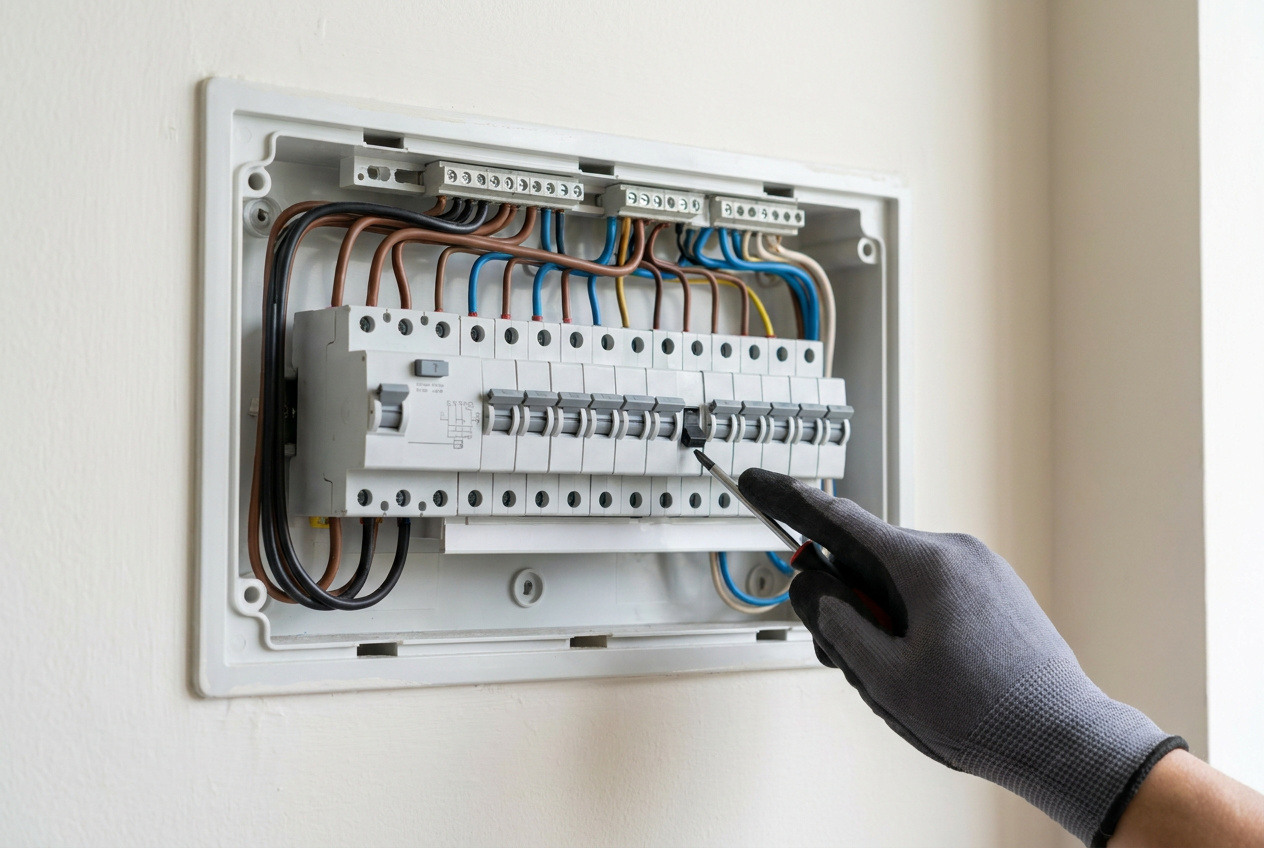
Open your DB box and you might spot a switch marked ELCB or RCCB. It is easy to wonder what it actually does, and whether yours is the type you are supposed to have. This single device is one of the most important safety parts in your home, and in Singapore the rules around it have shifted.
Here we explain what ELCB and RCCB devices do, where they differ, and what the RCCB requirement means for your home.
What is an ELCB?
An ELCB (Earth Leakage Circuit Breaker) is an older style of earth leakage protection. You will mostly find it in Singapore homes built before 1985.
The classic ELCB works off voltage. It watches the voltage on the earth conductor in your system. Normally that conductor carries no voltage. If a fault sends current down the earth path, the voltage on it climbs, the ELCB notices, and it trips.
That gives you some protection, but it has weak spots. The biggest one is that it leans on a healthy earth connection. If the earth wire is damaged, loose, or has high resistance, the ELCB may simply miss the fault. It also cannot catch current that travels by a route that does not touch the earth conductor, for example current passing through a person standing on a wet floor.
One point matters for compliance. The word ELCB gets used loosely here. The voltage-operated ELCBs are the ones with real detection gaps, and these are the devices EMA wants replaced. Current-operated ELCBs are a different story: they work the same way a modern RCCB does, by comparing live and neutral current. So if your device says ELCB but is current-operated, it is effectively an RCCB and stays legally compliant. A Licensed Electrical Worker can tell which is which during an inspection.
What is an RCCB?
An RCCB (Residual Current Circuit Breaker) is the modern replacement for the ELCB, and it is now the standard for home electrical work in Singapore.
The RCCB is a current-operated device. It constantly measures the current going out on the live wire against the current coming back on the neutral. In a healthy circuit the two match. If they differ by more than the rated sensitivity (usually 30mA for homes), current is escaping somewhere it should not, and the RCCB trips.
The big advantage is that the RCCB does not rely on the earth connection to do its job. It senses the imbalance no matter which path the leakage takes. So it covers situations an ELCB would miss, such as current running through someone who touches a live part while standing on a wet surface.
ELCB vs RCCB: the key differences
The points below compare voltage-operated ELCBs with RCCBs, since these are the two EMA does not treat as equivalent.
- Detection method: the voltage-operated ELCB reads voltage on the earth conductor; the RCCB reads current imbalance between live and neutral.
- Depends on the earth connection: yes for the ELCB, no for the RCCB.
- Detects current through a person: the ELCB only if the earth path is involved; the RCCB yes, whatever the path.
- Typical sensitivity: varies for the ELCB; 30mA is the household standard for the RCCB.
- Trip speed: slower for the ELCB; the RCCB trips in max 40ms at five times rated residual current and max 300ms at rated sensitivity (IEC 61008 / SS 97).
- Common in: voltage-operated ELCBs in homes built before 1985; RCCBs in homes from 1985 onward and renovated properties.
- Current status: EMA expects voltage-operated ELCBs to be replaced, and the RCCB is the required standard. The 2025 amending regulation is the Electricity (Electrical Installations) (Amendment) Regulations 2025 (S 454/2025), published 30 June 2025.
Singapore's RCCB installation mandate
The RCCB retrofit requirement comes from the Energy Market Authority (EMA), not HDB directly. EMA requires every residential property built before 1985 to have an RCCB (or a compliant current-operated ELCB) fitted; the relevant 2025 amending instrument is the Electricity (Electrical Installations) (Amendment) Regulations 2025 (S 454/2025), published 30 June 2025. Per EMA, the enforcement date was 1 July 2025, and homes without one may face a fine of up to S$5,000. This sits inside the wider set of Singapore electrical rules covering safety in homes.
The requirement covers all pre-1985 homes: HDB flats, private condos, and landed houses. For homes built in 1985 or later, RCCB protection has been part of the standard installation already, so most newer places already comply. HDB helps run the rollout across HDB stock, but it does not own the underlying rule.
EMA also makes one important distinction. Only voltage-operated ELCBs need replacing. Current-operated ELCBs are functionally the same as RCCBs and stay compliant. If your device says ELCB but your Licensed Electrical Worker confirms it is current-operated, you do not need to replace it.
Subsidy for pre-1985 HDB flats
Pre-1985 HDB flats qualify for a joint EMA-HDB subsidy that cuts or removes the cost of the retrofit:
- 1-room and 2-room flats: 100% subsidy, so it is fully covered.
- 3-room and larger flats: 95% subsidy, so you pay a small co-payment.
What the upgrade involves
Condos, landed homes, and post-1985 properties carry the full retrofit cost themselves. If you are an eligible HDB homeowner, check enrolment details with HDB or on the EMA website before you pay a private electrician.
The upgrade itself is simple. A Licensed Electrical Worker checks your DB box, removes the old voltage-operated ELCB, fits an RCCB, reconnects the circuits, and tests the work. It usually takes one to two hours. Our HDB ELCB service covers the whole job, from assessment through to testing.
Does your HDB have the right protection?
To see what earth leakage protection your flat has, open the DB box and look at the device sitting between the main switch and the row of MCBs.
- If it says RCCB (or RCD): you already have the current standard. Test it monthly with the test button; it should trip straight away.
- If it says ELCB: ask a Licensed Electrical Worker to confirm whether it is voltage-operated or current-operated. Voltage-operated ones should be replaced with an RCCB, as EMA expects. Current-operated ones are equivalent to an RCCB and stay compliant, so no swap is needed.
- If there is no ELCB or RCCB at all: your flat has no earth leakage protection. That is a priority upgrade, both for safety and for EMA compliance if your home predates 1985.
Cost of ELCB and RCCB installation and upgrade
Before you look at private pricing, check whether you qualify for the subsidy. Pre-1985 HDB flats get the joint EMA-HDB subsidy that covers 100% of the retrofit for 1-room and 2-room flats and 95% for 3-room and larger flats. Eligible households pay little or nothing.
For homes outside the subsidy (post-1985 properties, condos, and landed homes), the figures below are rough ranges for the Singapore private market. Actual prices move with the provider, the device, and the site, so always ask for an itemised quote.
What it costs depends on the state of your existing DB box and whether extra work is needed to fit the new RCCB. A clean swap into a compatible DB box is the cheapest route. All work must be done by a Licensed Electrical Worker who can test and certify it. Our licensed electrical works service gives clear pricing for every ELCB and RCCB job.
- ELCB to RCCB swap (compatible DB box): S$150 to S$250.
- ELCB to RCCB with DB box modifications: S$250 to S$350.
- Full DB box replacement with RCCB: S$350 to S$800.
- RCCB testing only (if already installed): S$50 to S$100.
What is the difference between ELCB and RCCB?
Both protect against earth leakage, but they sense faults differently, and the RCCB is the newer, more reliable technology.
The classic ELCB is voltage-operated. It watches the voltage on the earth conductor and trips when that voltage rises. The catch is that it needs a good earth connection. If the earth wire is broken or has high resistance, it may not catch the fault.
An RCCB is current-operated. It keeps comparing the current leaving on the live wire with the current returning on the neutral. If they differ by more than the rated sensitivity (typically 30mA at home), current is leaking somewhere, and it trips. Because it does not depend on the earth connection, it is more dependable.
One practical note: EMA separates voltage-operated ELCBs (which must be replaced) from current-operated ELCBs (which are equivalent to RCCBs and stay compliant).
Is RCCB mandatory in Singapore HDB flats?
Yes, though the rule comes from EMA, not HDB directly. Per EMA, all homes built before 1985 (HDB flats, condos, and landed houses) must have an RCCB; the 2025 amending instrument is the Electricity (Electrical Installations) (Amendment) Regulations 2025 (S 454/2025), published 30 June 2025. EMA set the enforcement date at 1 July 2025, with a fine of up to S$5,000 for non-compliance. Homes built in 1985 or later already had RCCB protection as part of the standard installation.
A useful distinction: only voltage-operated ELCBs must be replaced; current-operated ELCBs stay compliant. Pre-1985 HDB flats qualify for the joint EMA-HDB subsidy (100% for 1-2 room flats, 95% for 3-room and larger). The upgrade takes one to two hours with little disruption.
How much does RCCB installation cost in Singapore?
Start with subsidy eligibility. Pre-1985 HDB flats get the joint EMA-HDB subsidy covering 100% of the retrofit for 1-room and 2-room flats and 95% for 3-room and larger flats, so eligible households pay little or nothing. Confirm enrolment with HDB or the EMA website before paying privately.
For homes outside the subsidy (post-1985 properties, condos, and landed homes), private-market RCCB installation usually runs from S$150 to S$350 as a guide. Actual pricing shifts with the provider, the device, and DB box condition. A full DB box replacement is typically S$350 to S$800. Always get an itemised quote from a Licensed Electrical Worker first.
Can I replace my ELCB with an RCCB myself?
No. This work has to be done by a Licensed Electrical Worker (LEW). It means working near live terminals, wiring the live, neutral, and load connections correctly, and testing afterwards with a calibrated RCD tester. A wrongly wired RCCB could fail to protect you when it matters most. For a safe, compliant upgrade, use our licensed electrical works service.
Why does my ELCB keep tripping?
Common reasons include faulty appliances with internal insulation faults, ageing wiring insulation in older flats, moisture in outlets or junction boxes, and an old ELCB that has turned oversensitive. If your ELCB is more than 15 years old and trips often, the device itself may be due for replacement. Moving up to a modern RCCB often clears persistent tripping.
What happens if I don't install an RCCB by the deadline?
Per EMA, the enforcement date for pre-1985 homes was 1 July 2025, and non-compliance may carry a fine of up to S$5,000. The 2025 amending instrument is the Electricity (Electrical Installations) (Amendment) Regulations 2025 (S 454/2025), published 30 June 2025. It can also surface during a resale or when seeking renovation approvals. For pre-1985 HDB flats, the joint EMA-HDB subsidy covers 100% of the cost for 1-2 room flats and 95% for 3-room and larger. Outside the subsidy, a straightforward swap is indicatively S$150 to S$350, depending on the provider.
Do condos need to comply with the RCCB mandate?
Yes. The EMA requirement covers all pre-1985 homes, condos and landed houses included, not just HDB flats; the 2025 amending instrument is the Electricity (Electrical Installations) (Amendment) Regulations 2025 (S 454/2025), published 30 June 2025. Per EMA, the enforcement date was 1 July 2025, with a fine of up to S$5,000. For condos built in 1985 or later, RCCB protection has already been required under SS 638 as part of the standard installation. The EMA-HDB subsidy applies to HDB flats specifically; condo owners carry the retrofit cost themselves, though pricing is broadly similar to HDB work.
Ensuring compliance
Swapping an ELCB for an RCCB is one of the simplest, highest-value safety improvements you can make at home. It takes a couple of hours and gives you measurably better protection against electric shock. If your home predates 1985, EMA also requires it, with a fine of up to S$5,000 after the 1 July 2025 enforcement date. The 2025 amending instrument is the Electricity (Electrical Installations) (Amendment) Regulations 2025 (S 454/2025), published 30 June 2025.
The good news for pre-1985 HDB homeowners is the joint EMA-HDB subsidy: 100% of the retrofit for 1-room and 2-room flats and 95% for 3-room and larger flats. If you qualify, confirm enrolment with HDB or on the EMA website before paying a private electrician.
Not sure what you have? Check your DB box, or have a Licensed Electrical Worker inspect it, especially to confirm whether an existing ELCB is voltage-operated (replace) or current-operated (keep). For the upgrade itself, our HDB ELCB service handles assessment, installation, testing, and certification in one visit.