How to Verify an Electrician Licence in Singapore: The ELiSE Guide
Use EMA's free ELiSE portal to confirm an electrician is properly licensed, understand the licence grades, and recognise the warning signs of illegal work.
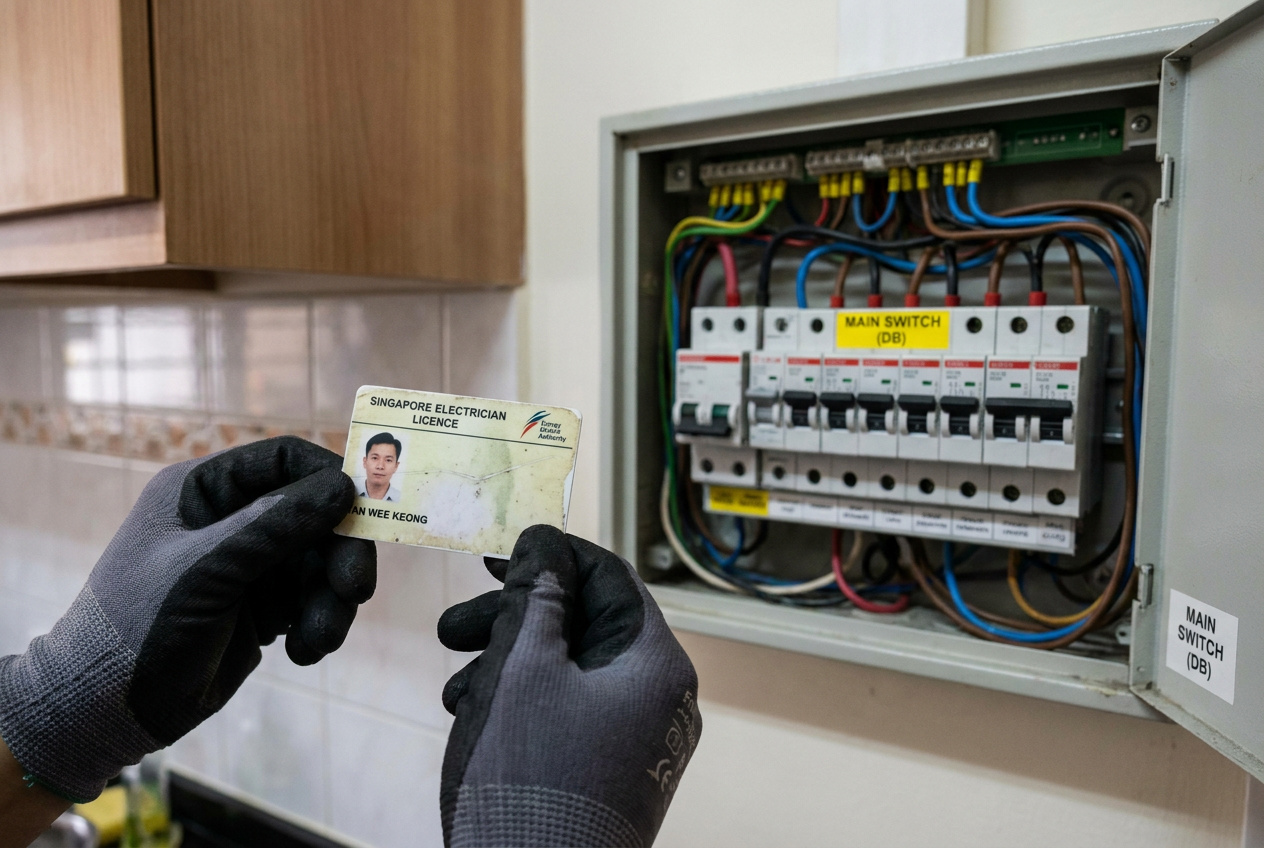
When electrical work goes wrong in Singapore, the results can be serious: fires, electrocution, and property damage that your insurer will not cover if an unlicensed person did the job. Yet plenty of homeowners are not sure how to confirm their electrician is genuinely licensed.
The good news is that Singapore's Energy Market Authority (EMA) runs a free public system called ELiSE (e-Licence Information Services). Anyone can use it to check an electrician's credentials in minutes.
In this guide we cover how to use the ELiSE portal, what the licence grades mean for your project, and the red flags that point to someone working illegally.
Why verifying licences matters
Under Singapore's Electricity Act, all electrical installation work must be done by a Licensed Electrical Worker (LEW) registered with the EMA. This is not just red tape. It is a safety framework that protects lives and property.
The legal picture is blunt. If unlicensed work causes a fire or injury, you as the property owner can face penalties under the Electricity Act, your insurance claim is likely to be refused, and in an HDB flat you could be held responsible for damage to neighbouring units.
Checking also protects you from people who claim to be licensed but are not. Some show fake certificates, some hold expired licences, and a few are licensed in a grade that does not cover the work they are proposing.
ELiSE removes the guesswork. It is the official EMA record, updated as licences are issued, renewed, suspended, or revoked.
Singapore's LEW licence grades
Singapore's LEW system uses three grades that set out what an electrician can legally do.
- Grade 7 (L7) Licensed Electrician: installations up to 45kVA and 1,000V. This covers most residential work, HDB flats and private homes included. For typical jobs (outlets, lighting upgrades, ceiling fans, DB box work) Grade 7 is enough.
- Grade 8 (L8) Licensed Electrical Technician: installations up to 500kVA (design up to 150kVA) at 1,000V. Needed for larger homes, commercial fit-outs, food courts, small factories, and MCST common-area work. Grade 8 can also supervise Grade 7 electricians on larger jobs.
- Grade 9 (L9) Licensed Electrical Engineer: the highest level, covering high-voltage systems up to 400kV depending on licence conditions. Required for large industrial sites, substations, and infrastructure.
For homeowners, make sure your electrician holds at least Grade 7 for standard residential work, or Grade 8 if your property's load runs above 45kVA.
Using EMA's ELiSE portal, step by step
Accessing the portal. Go straight to elise.ema.gov.sg, or visit www.ema.gov.sg and head to Regulations & Licences, then Worker Licences, where you will find a link to the 'Search for Licensed Electrical Workers' database. Both routes open the same ELiSE portal. No registration or login is needed. Always use the official EMA system rather than third-party sites.
Running a search
You can search by:
- LEW Licence Number: the most direct method if you have it from their quote.
- Name: full name, though common names may return several results.
- Company Name: find every LEW registered to a business.
- Licence Grade: filter by Grade 7 (L7), 8 (L8), or 9 (L9).
Reading the results
- Licence Status is the field that matters most. Look for 'Valid' or 'Current'. If you see 'Expired', 'Suspended', or 'Revoked', do not hire this person.
- Licence Grade confirms what they can legally do. Check it matches your project.
- Validity Period shows the expiry date. For longer projects, confirm they will renew if needed.
- Company Registration should match the business you are dealing with. A mismatch is a red flag.
If you can't find a record
If your search returns nothing:
- They may not be licensed at all. Do not hire them.
- They may have given incorrect details. Ask for their official LEW certificate.
- Their licence may have expired. Ask them to confirm with EMA.
- Search by company name instead if they work for a contractor.
Never go ahead with electrical work if you cannot verify the licence through ELiSE.
Company versus individual licences
When you hire a contractor company, search the company name in ELiSE and look for:
- Several licensed electricians across different grades
- Current validity dates for key staff
- Grades that suit the work they claim to handle
When you get quotes, ask which specific LEW will do your work and verify that individual. Some companies keep a licensed electrician for oversight but send unlicensed helpers to the job. That is illegal.
For our licensed electrical works, we make sure every electrician holds a current licence at the appropriate grade.
Red flags: when something doesn't add up
- Reluctance to share licence details is the biggest warning sign. Genuine LEWs expect you to check.
- Prices far below other quotes deserve a closer look. Licensed electricians build real costs into their pricing: insurance, renewals, training.
- Pressure to start at once without proper paperwork often means someone is stopping you from checking credentials.
- Cash-only with no receipt suggests someone dodging proper business registration.
- Mismatched grades. If ELiSE shows Grade 7 but they are proposing work above 45kVA without Grade 8 supervision, they are planning work beyond their scope.
- Offering to 'skip the paperwork' means illegal work that will haunt you when you sell or claim on insurance.
Trust your instincts. If something feels off, the verification process is there to protect you.
What to do after verifying
Before work begins: get written details of the LEW's name, number, and grade. Take a photo of their physical LEW licence card.
During the project: make sure the licensed person is the one actually doing the electrical work. If they drop off helpers and vanish, that breaks the rules.
For HDB projects: your LEW submits the Certificate of Compliance to EMA once the electrical work is done. If your project adds electrical load, SP Services (or SP Group) must approve the load change. HDB's role is to approve the overall renovation package through the HDB-licensed renovation contractor, not the electrical installation itself. Check each step is done correctly.
On completion: ask for documentation signed by the LEW and keep it with your property records.
For ongoing upkeep through our preventive electrical maintenance programme, re-check licences each year.
The legal side
Under the Electricity Act, property owners can be held responsible for non-compliant electrical work on their premises, including work done by unlicensed people. 'I didn't know' is not a defence.
Criminal penalties can apply where unlicensed installation work happens on your property. Offenders face fines of up to S$10,000, up to 12 months in prison, or both. The penalties get more serious if the work leads to fire, electrocution, or property damage.
Civil liability: if unlicensed work damages a neighbour's property, your insurer is likely to deny cover.
Insurance: an insurer who finds unlicensed work may void your entire policy.
HDB: compliance issues tied to unapproved renovation can delay or derail a sale, and breaking HDB renovation rules may bring penalties or enforcement action.
Questions worth asking a licensed electrician
Beyond verifying the licence, these questions help you spot a true professional.
- How long have you held your current grade?
- Can you give references for similar projects?
- What insurance cover do you carry?
- How do you handle warranty and callback issues?
- What documentation will I get on completion?
- Are you familiar with my property type (HDB, condo, landed)?
Frequently Asked Questions
How do I access the ELiSE portal? Go directly to elise.ema.gov.sg, or visit www.ema.gov.sg and head to Regulations & Licences, then Worker Licences, where you will find the 'Search for Licensed Electrical Workers' link. The portal is free, needs no login, and shows licence status, grade, validity, and company registration in real time. It works on mobile too, which makes on-site checks easy.
What are the LEW grades in Singapore? There are three. Grade 7 (L7) Licensed Electricians handle installations up to 45kVA and 1,000V, covering nearly all standard residential work. Grade 8 (L8) Licensed Electrical Technicians handle up to 500kVA (design up to 150kVA) at 1,000V, needed for larger commercial work. Grade 9 (L9) Licensed Electrical Engineers handle high-voltage systems up to 400kV for industry and infrastructure. For a typical HDB flat or private home, Grade 7 is enough; above 45kVA you need Grade 8.
Which grade do I need for HDB work? For most HDB flats, Grade 7 (L7) is enough, since their loads sit well under 45kVA. If your home has unusually high demand above 45kVA, you need Grade 8 (L8). Grade 9 is rarely needed at home as it is for high-voltage systems. Always confirm through ELiSE that your electrician holds at least Grade 7.
What if the electrician I hired isn't properly licensed? Stop work at once, document everything (photos, messages, receipts), and have a licensed electrician assess it. Do not pay for unlicensed work. Report the matter to EMA so others are not caught out. Have the work redone by licensed professionals. Yes, that can mean paying twice, but safety and compliance require it.
How often do licences need renewing? LEW licences typically renew every 1 to 3 years. When you check ELiSE, look at the Validity Period for the expiry date. If a licence is close to expiry and your project runs for months, confirm the contractor will renew. An expired licence means no legal work until renewed.
What does ELiSE show about an electrician? Licence Status (Valid, Expired, Suspended, or Revoked), Licence Number, Licence Grade (L7, L8, or L9), Validity Period, and Company Registration. Only proceed if the status is Valid. Note that ELiSE does not carry reviews or complaint history; it is purely a licensing tool. Gather quality feedback through references and reviews separately.
In summary
Checking a licence through ELiSE takes minutes and gives you authoritative confirmation that the person you are hiring meets Singapore's legal requirements.
Remember the steps: open ELiSE through the official EMA site, search by licence number or name, confirm the licence is current and at the right grade, and make sure the licence holder is the one actually doing your work.
The cost of unlicensed work (safety risks, legal liability, denied insurance) far outweighs any saving. When you want it done right, explore our licensed electrical works, carried out by fully qualified, EMA-verified electricians.