What to Do When Your Power Trips in Singapore
Lights out mid-dinner? Here is how to respond to a power trip, reset your DB box safely, and decide whether you need SP Services or an electrician.
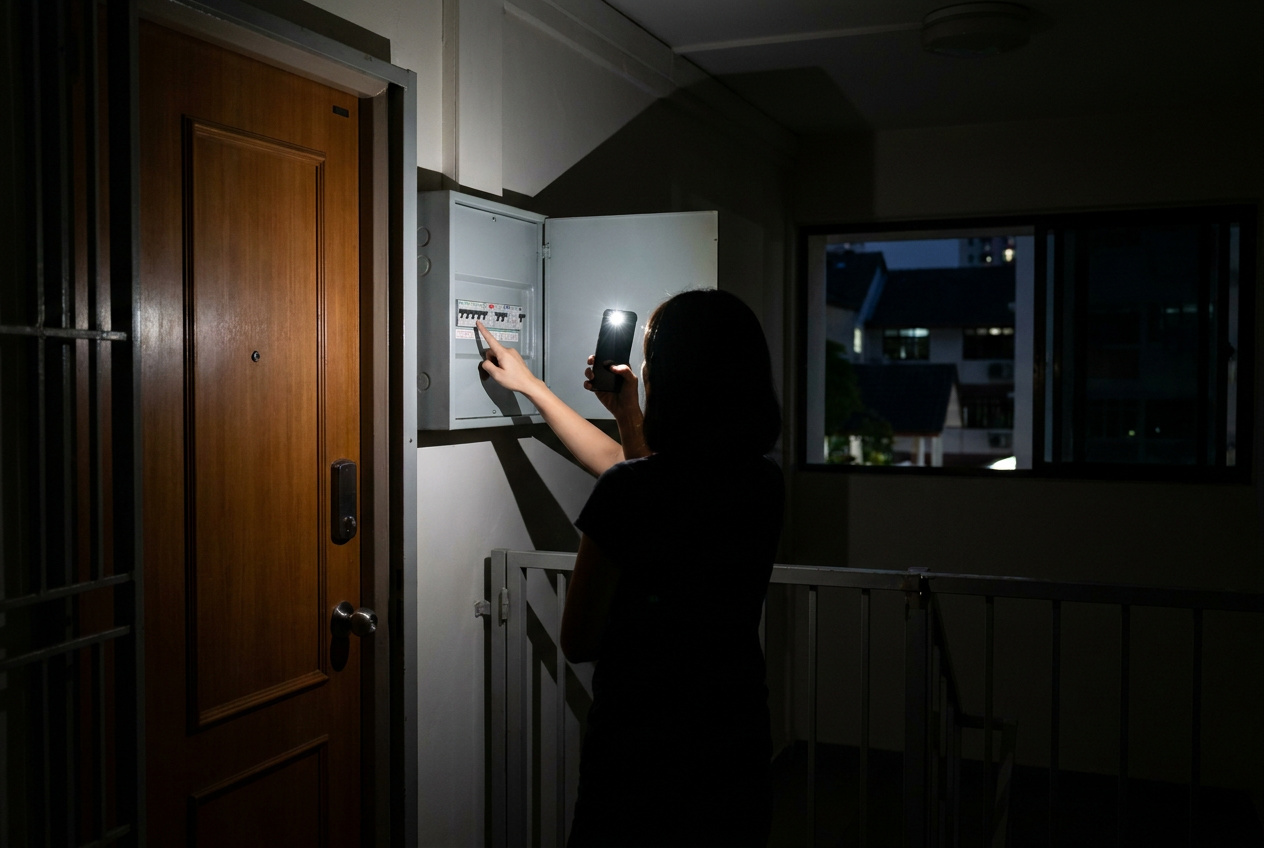
You are halfway through cooking, watching television, or about to fall asleep, and suddenly everything goes dark. Your power has tripped. It is one of the most common household disruptions in Singapore, and while it is rarely dangerous in itself, how you respond matters.
Here we walk you through what to do when your power trips, from the first steps to deciding whether you need SP Services or an electrician.
Why does power trip in Singapore homes?
Power trips happen when your protection system spots a problem and cuts the power to prevent damage or injury. Here are the common causes.
- Circuit overload: the most frequent reason. When too many appliances draw from one circuit at once, the total current exceeds the MCB's rating and it trips. This is especially common in older HDB flats with fewer circuits.
- Faulty appliance causing a short circuit: when an appliance's internal wiring fails, it can cause a sudden current surge that trips the breaker instantly, the moment the faulty device is switched on.
- ELCB or RCCB tripping from earth leakage: your earth leakage protection senses current taking an unintended path and cuts the power. Often triggered by moisture in outlets, deteriorating appliance insulation, or damaged wiring.
- Ageing wiring in older HDB flats: in flats built before the 2000s, insulation can degrade over decades, leading to micro-leakage that trips the RCCB or, in worse cases, short circuits that trip MCBs.
- Moisture-related trips: kitchens, bathrooms, and laundry areas are prone to moisture reaching connections, especially during heavy rain or when water splashes near outlets.
How to safely reset your DB box
Follow these steps to restore power safely.
- Step 1: switch off and unplug as many appliances as you can. This takes the load off the circuits and helps stop the breaker tripping again straight after reset.
- Step 2: locate your DB box. In most HDB flats it is near the front door, mounted at roughly eye height. In condos and landed homes it may be in a utility area or store room.
- Step 3: open the cover and find the switch in the middle or off position. That is your tripped breaker. If your circuits are labelled, note which area it controls.
- Step 4: push the tripped switch firmly to off first, then back to on. Some need a firm push. If it holds in the on position, the reset worked.
- Step 5: reconnect appliances one at a time, waiting a couple of minutes between each. If the breaker trips when a specific appliance goes on, that appliance is likely the cause. If it trips immediately with nothing connected, there is a wiring fault; do not keep resetting, and call an electrician.
SP Services or electrician: who should you call?
This is one of the most common questions during a power trip, and calling the wrong one wastes time.
- Call SP Services when: the whole block or area has lost power (not just your flat); your DB box shows no tripped switches but you have no power; there is visible damage to external power infrastructure (cables, substations); or your electricity meter is not working. SP Services handles the supply network, and their emergency line is 1800-778-8888.
- Call a private electrician when: only your flat has lost power; a breaker in your DB box has tripped; you have a burning smell, sparking outlet, or other internal fault; your breaker keeps tripping after reset; or you need after-hours or weekend help.
Our response for internal trips
For internal power trips and electrical faults, our emergency electrician service responds 24 hours a day. For HDB-specific outages, our HDB power outage emergency service is built for quick diagnosis and restoration.
When power trips become dangerous
Most power trips are harmless, but certain signs point to something more serious.
- Burning smell: if you smell burning near your DB box, an outlet, or in the wall, switch off the main power immediately. A burning smell means overheating, which can lead to fire. Do not try to reset the breaker.
- Repeated trips on the same circuit: a breaker that trips again and again despite removing suspected faulty appliances may point to a wiring fault. Each force-reset risks arcing and heat damage at the fault point.
- Scorched outlets or switches: black marks, melted plastic, or discolouration around an outlet or switch means there has been excessive heat. Stop using that outlet and have it inspected, as the fault may run deeper than it looks.
Why does my power keep tripping at night?
Night-time trips are often linked to appliances that run during those hours. Water heaters used for evening showers are a frequent culprit, especially older units with earth leakage from limescale or moisture damage to the element. Air conditioners left running overnight can trip breakers too, particularly if the compressor has a developing fault that causes irregular draw as the unit cycles.
Another cause is the cumulative evening load. When everyone is home using the aircon, television, rice cooker, washing machine, and water heater together, the combined current on shared circuits can exceed the MCB rating. Circuits that cope fine in the day can struggle once evening usage piles up.
Moisture-related trips also tend to happen at night in some flats, as temperature drops cause condensation on poorly insulated wiring or inside outdoor enclosures. If your power trips at the same time each night, track which appliances are on then. Remove one from the mix and see if the tripping stops. If the timing varies but is always at night, the issue may be cumulative load, and a dedicated circuit could solve it.
How much does it cost to fix a power trip in Singapore?
The cost ranges from nothing (if you fix it yourself by unplugging a faulty appliance) to several hundred dollars for professional repairs. For a straightforward diagnostic and fix during normal business hours, expect S$80 to S$200, covering the visit, fault diagnosis, and a simple repair like tightening a loose connection or replacing a single MCB.
If the trip is down to a faulty appliance rather than wiring or the DB box, fixing or replacing the appliance is your main cost, and the electrician just confirms the diagnosis. Common repair costs include a single MCB replacement at S$80 to S$150, RCCB replacement at S$150 to S$300, and outlet or switch replacement at S$50 to S$120.
If the issue is more complex, such as degraded insulation or an overloaded circuit needing an extra dedicated run, costs rise, with adding a new circuit typically S$150 to S$350. Emergency or after-hours call-outs carry a surcharge, usually 50 to 100 per cent above standard rates.
Can a power trip damage my appliances?
A power trip itself rarely damages most modern appliances, since it is essentially an abrupt power cut. But there are situations where damage can occur alongside a trip.
Compressor-based appliances like fridges and air conditioners are the most vulnerable. When power returns and the compressor tries to restart against high system pressure, it can strain or damage the motor. Most modern units have restart-delay protection, but older models may not. Computers and network gear can lose unsaved data during a trip, and in rare cases a sudden loss of power during a write can corrupt a storage drive.
The real damage risk comes not from the trip but from the fault causing it. If a trip is caused by a voltage surge, that surge may have already hit connected devices before the breaker responded. Repeated tripping and resetting also stresses appliance components, since each abrupt shutdown and restart wears on motors, compressors, and control boards. If your power trips often, fixing the root cause protects both your safety and your appliances.
What is the difference between MCB and ELCB tripping?
An MCB trip and an ELCB trip point to different faults, and knowing which one tripped tells you a lot.
When an MCB trips, the current through that specific circuit exceeded the breaker's rating, usually from overload (too many appliances) or a short circuit (live and neutral touching). Only that circuit loses power, while the rest of the flat stays on. An MCB trip points to a problem on that one circuit.
When the ELCB (or its modern equivalent, the RCCB) trips, current is leaking from the intended path to earth. This protects against shock, and it usually cuts power to all circuits connected to it, so most or all of your flat goes dark. To find the circuit, reset the ELCB with all MCBs off, then switch on MCBs one at a time. The MCB that makes the ELCB trip again is the one with the earth leakage fault.
Should I call SP Services or an electrician when my power trips?
It depends on whether the problem is on the supply side (SP Services) or inside your flat (an electrician). Call SP Services (1800-778-8888) if your whole block or neighbourhood has lost power, not just your flat. Also call them if your power is out but nothing in your DB box has tripped, which suggests a supply interruption.
Call a private electrician if only your flat is dark while neighbours have power, or if a breaker in your DB box has tripped, since that points to an internal fault. A common mistake is calling SP Services for internal faults: they will not repair your internal wiring, DB box, or appliances. They will check the supply and, if it is fine, tell you to call a private electrician.
Save time with a quick check first: open your DB box and look for a tripped switch. If you find one, the issue is internal and you need an electrician.
How do I know which circuit breaker tripped in my DB box?
It is straightforward once you know what to look for. Open the DB box cover (usually a grey metal or plastic panel near your front door) and check the toggle switches. A tripped breaker sits either in the middle (halfway between on and off), which is the most common, or fully off. Some have a small coloured window that shows green when on and red when tripped.
If your DB box has circuit labels, the card tells you which part of your flat is affected. If there are no labels, switch the tripped breaker back on and see which sockets and lights return. Take the chance to label your circuits for next time.
Sometimes the RCCB trips rather than an individual MCB. The RCCB is the larger switch, usually near the top below the main switch. When it trips, it cuts all the circuits it covers, so it can look like the whole flat has lost power. Check both the individual MCBs and the RCCB when investigating.
Is it safe to keep resetting a tripping circuit breaker?
Resetting a tripped breaker once or twice to test whether the problem persists is fine. But repeatedly resetting one that keeps tripping is not safe and should be avoided.
Each time a breaker trips and is reset immediately, you force current through a circuit that has a fault. If the fault is a short circuit or earth leakage, each reset briefly exposes the fault before the breaker trips again. That can cause arcing at the fault point, generating intense heat that can damage insulation and, in extreme cases, start a fire.
Repeated resetting also wears out the breaker's trip mechanism. If a breaker trips more than twice in a row, stop. Leave it off, work out what was connected to that circuit, and either isolate the faulty appliance or call an electrician.
Keeping your electrical system safe
Power trips are a normal part of living with electricity. They are your system's safety mechanism doing its job. The key is knowing how to respond, when to handle it yourself, and when to call for help.
Spread high-power appliances across different circuits. Test your RCCB monthly. Label your DB box circuits. And if tripping becomes frequent or comes with warning signs, do not delay in getting professional help. For reliable diagnosis and repair, reach out about our electrical troubleshooting service or our HDB ELCB service for earth leakage protection upgrades.