What Work Requires a LEW in Singapore? The Complete List
A clear breakdown of which electrical jobs in your home legally need a Licensed Electrical Worker, which ones you can handle yourself, and what happens if you get it wrong.
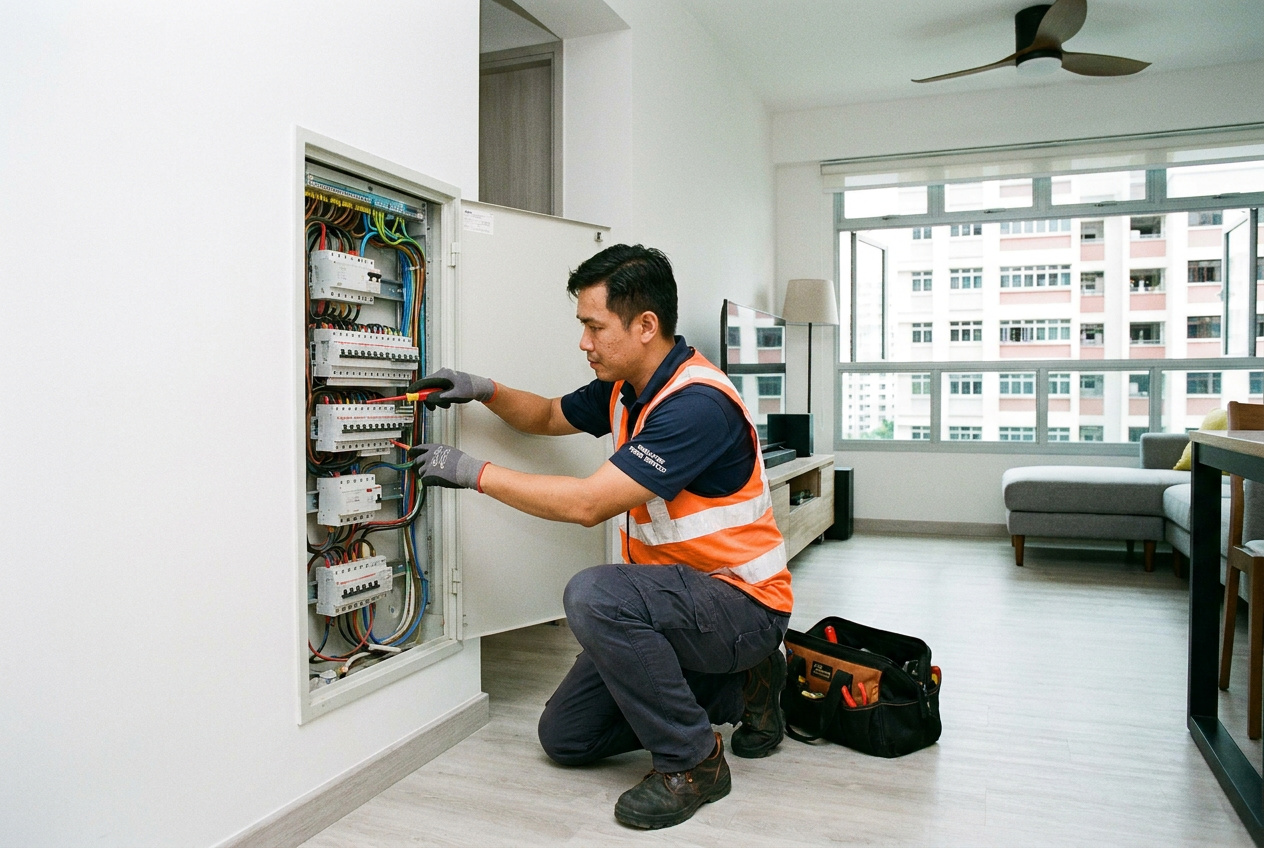
Not every job around the house needs a Licensed Electrical Worker. Swapping a light bulb, plugging in a kettle, or popping a new fuse into a plug is fine on your own. The moment you start touching the fixed wiring of your property, though, the law is very specific about who is allowed to do the work.
We put this guide together so you know exactly where you stand. Below you will find which work legally needs a LEW, which jobs sit in a grey area, and what the real consequences are if unlicensed work goes ahead.
Work that legally needs a LEW
Under the Electricity Act and its supporting regulations, the jobs below count as electrical installation work. That means a Licensed Electrical Worker must carry them out.
Distribution board (DB box) work
- Replacing the DB box
- Adding new circuits to the board
- Upgrading the main switch
- Fitting or replacing the RCCB or ELCB
- Changing how the circuits are configured
Wiring and rewiring
- Rewiring a whole property
- Partial rewiring of selected circuits
- Running new cables for extra circuits
- Replacing worn or damaged wiring
New installations
- Adding new power points to the fixed wiring
- Installing hardwired light fittings
- Hardwiring a ceiling fan into the circuit
- Installing and connecting a water heater
- Wiring up an air conditioning unit
- Installing an EV charger
- Commercial fit-outs (offices, retail, F&B)
Connection and certification
- Connecting a property to the electrical supply
- Testing and certifying an installation
- Issuing completion certificates for installation work
- Periodic inspection and testing of licensed installations
Changes to the supply
- Upgrading from single-phase to three-phase supply
- Increasing supply capacity through SP Services
- Installing standby generators or UPS systems tied into the fixed wiring
Work that does not need a LEW
Some tasks never touch the fixed wiring, so they are not classed as installation work. You can do these yourself.
Appliance-level tasks
- Changing a bulb or fluorescent tube
- Replacing the fuse inside a plug
- Plugging and unplugging portable appliances
- Resetting a tripped MCB or RCCB at the board
- Pressing the test button on the RCCB
Portable equipment
- Using extension cords and power strips
- Setting up portable lamps and desk lights
- Connecting plug-in timers and smart plugs
- Using plug-in surge protectors
Low-voltage gear (usually)
- Plugging in USB chargers and adapters
- Connecting low-voltage LED strips that run off a plug-in transformer
- Fitting battery-operated devices such as smoke detectors and doorbells
The simple rule of thumb
The dividing line is the fixed installation versus portable or plug-in equipment. If you can do it with a plug, it is generally not installation work. If it means opening a junction box, joining onto fixed wiring, or reaching inside the DB box, it is.
Grey-area jobs: play it safe
A handful of jobs sit in a practical grey area. The rules are clear that they count as installation work, but the low risk and light enforcement create some confusion. Here is how we see them.
Swapping a light switch like-for-like. Technically this is installation work. In practice it means disconnecting and reconnecting wires at the switch. A careful homeowner who can isolate the circuit and test for dead can manage it. Once you change anything (fitting a dimmer, adding a switch, or changing the switch type), the job gets more involved and is better left to a professional.
Replacing a socket faceplate. Much the same as a switch. A straight like-for-like swap is low risk if you understand basic electrical safety. Any change to the wiring behind the faceplate moves it into LEW territory.
Fitting a ceiling light. If the junction box and wiring are already there and you are simply connecting a new fitting to existing wires, some homeowners do this safely. If you are unsure about the wiring, or the fitting needs changes to the junction box or circuit, call us in.
Adding a USB socket. Replacing a normal socket with a USB version means working on the fixed wiring. The physical swap is simple, but the USB module adds a transformer and the socket has to suit your wiring.
Our guideline for grey-area work
If you understand electrical safety, can find and isolate the right circuit, can test for dead with a voltage tester, and are doing a simple like-for-like swap with no wiring changes, the risk is low. If any one of those is missing, bring in a LEW.
Penalties for non-compliant work
Singapore does not treat unlicensed electrical work lightly. The fallout is legal, financial, and physical.
- Legal penalties: under the Electricity Act, carrying out installation work without a licence can bring fines of up to S$10,000 and up to 12 months in prison. These can apply to the person doing the work and, potentially, to anyone who knowingly hires them.
- Insurance impact: if a fault from unlicensed work causes damage or injury, your property insurer may refuse the claim. That can extend to claims from affected neighbours too.
- HDB enforcement: for HDB flats, HDB can take action against owners who allow unlicensed work, which may affect your ability to sell, sublet, or apply for permits later.
- Resale headaches: if non-compliant work surfaces during a sale, you may need a LEW to redo or certify it at your own cost before the deal can close.
- Safety: beyond the paperwork, bad electrical work causes fires, shocks, and damage to the building's electrical system. These are not theoretical risks. They happen here.
How to find and verify a LEW
Checking a LEW is quick.
- Ask any electrician you are considering for their LEW licence number.
- Look the number up on the EMA ELISE portal at elise.ema.gov.sg.
- Confirm the name matches, the grade suits your work, and the licence is active.
For a full walkthrough of the ELISE portal, see our guide on searching the EMA LEW registry.
If you need LEW-certified work at home, our licensed electrical works cover the full residential scope. For HDB jobs, see our HDB and residential LEW services. For business premises, our commercial and industrial LEW services carry the right licensing.
Frequently Asked Questions
What is a Licensed Electrical Worker in Singapore? A LEW is a person licensed by the Energy Market Authority to carry out electrical installation work. They are the only people legally allowed to perform, supervise, or certify work on fixed electrical systems here. They are graded (Electrician, Electrical Technician, Electrical Engineer) by the scope of installations they can handle, from standard homes to large industry. Each LEW is personally responsible for the safety and compliance of their work. You can verify any LEW through the EMA ELISE registry.
Can I replace a light switch without a LEW? Strictly, swapping a switch counts as installation work needing a LEW. In practice, a like-for-like change by a homeowner who can isolate the circuit and test for dead is low risk. Anything more (a dimmer, a different switch type, or moving the switch) should go to a LEW.
What happens if work is done without a LEW? Fines up to S$10,000 and up to 12 months in prison. Insurance claims may be refused for faults tied to unlicensed work. HDB can take enforcement action. Resale can get complicated if non-compliant work is found. On top of that, poorly done work creates real fire and shock risks.
How do I check if someone is a licensed LEW? Search the EMA ELISE portal at elise.ema.gov.sg using their licence number (most reliable), full legal name, or company. Confirm the name matches, the grade fits, and the licence is active.
What are the LEW grades in Singapore? Electrician grade covers installations up to 1,000V and 45kVA (standard homes). Electrical Technician grade covers up to 1,000V and 500kVA (commercial). Electrical Engineer grade is the widest, including high-voltage work (industrial). Higher grades include the scope of the lower ones.
Do I need a LEW for a water heater? Yes. A water heater needs connecting to a dedicated circuit, which is installation work. Mixing electricity and water makes correct installation safety-critical. A LEW gets the circuit protection, cable sizing, earthing, and compliance right.
Is a LEW the same as a licensed electrician? 'Licensed electrician' is an informal term. The official title under the Electricity Act is Licensed Electrical Worker (LEW). Anyone calling themselves a licensed electrician should hold a LEW licence. If they cannot give you a valid licence number, the claim is not backed by the rules.
Compliance, kept simple
The rule is plain: if the work touches your fixed wiring, it needs a LEW. If it involves a plug or a battery, it does not. Grey areas exist, but when you are unsure, the safer and legally sound choice is always a licensed professional.
Verifying a LEW takes five minutes. The peace of mind, legal cover, and safety it buys you are worth far more.