Why Your Electricity Keeps Tripping and How to Stop It
Tripping once is an inconvenience. Tripping again and again is a warning. Here are the common causes in Singapore homes and how to isolate and fix them.
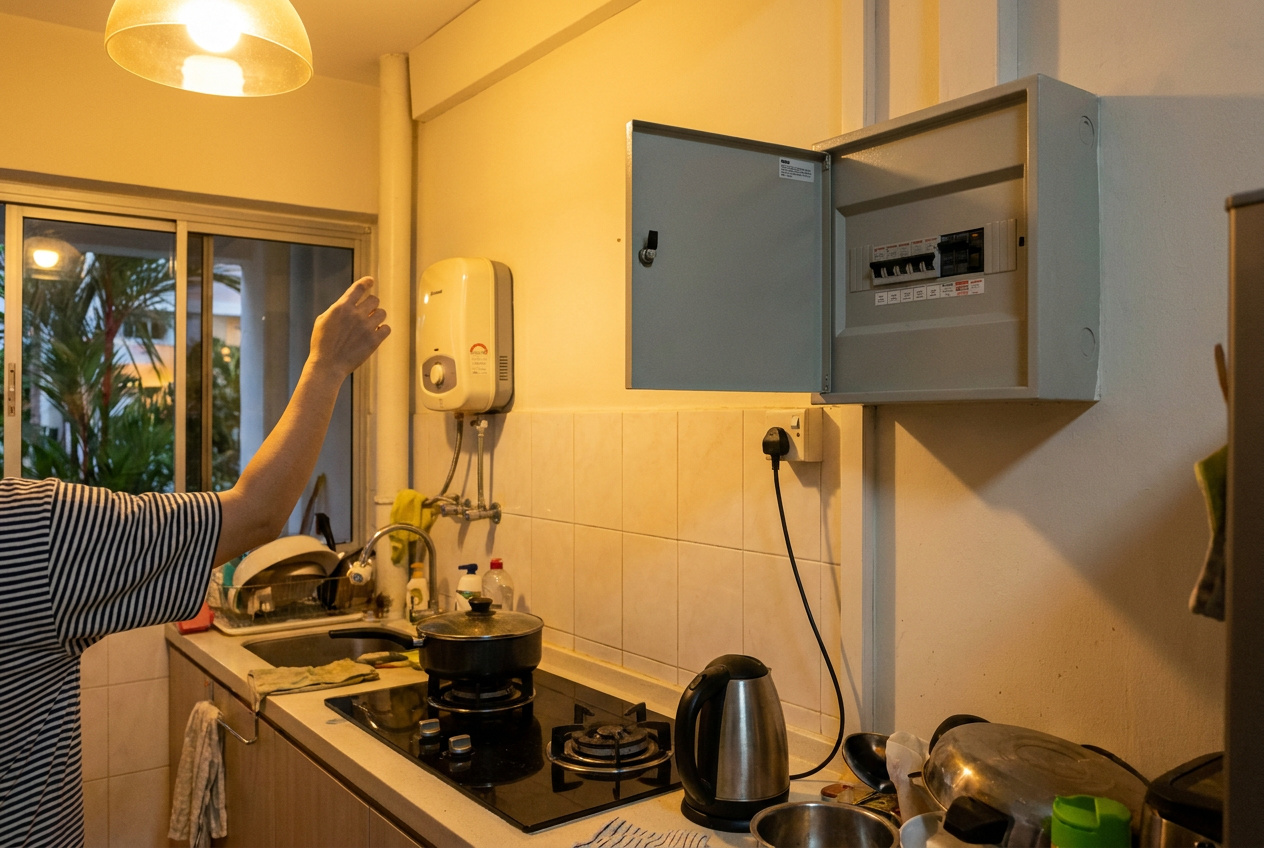
Electricity tripping once is annoying. Tripping over and over is a warning sign. If you find yourself walking to the DB box to reset a breaker more often than you would like, there is a reason, and ignoring it will not make it go away.
Here we run through the most common causes of tripping in Singapore homes and give you practical steps to isolate and fix the problem.
The 5 most common causes of electricity tripping
Tripping always has a cause. These are the five you will meet most often in Singapore.
- Circuit overload: the most common cause. Your circuits are rated for a set load, and running too many appliances at once exceeds it. This is especially common in older HDB flats where fewer circuits serve more devices than planned.
- Faulty appliance: an appliance with worn internal wiring or a failing component can cause irregular current draw or earth leakage. The tripping usually starts now and then, becoming more frequent as the fault worsens.
- Earth leakage: when current escapes by an unintended path (through damaged insulation, moisture, or an appliance fault), your RCCB or ELCB senses it and trips. That is a safety mechanism protecting you from shock.
- Deteriorating wiring: in flats over 20 years old, wiring insulation may be breaking down. As it does, it loses its ability to contain the current, leading to earth leakage and short circuits.
- Moisture intrusion: bathrooms, kitchens, and laundry areas are most at risk. Water reaching an outlet, switch, or junction box can create a leakage path that trips the RCCB.
How to isolate the problem yourself
Before calling an electrician, you can narrow down the cause with some systematic testing.
- Step 1: identify the tripped breaker. Open your DB box and find the switch in the middle or off position. Note which circuit it protects.
- Step 2: unplug everything on that circuit. Remove all plugged-in appliances and switch off any hardwired devices.
- Step 3: reset the breaker. Push it firmly to off, then switch it on. If it holds, the cause is likely an appliance.
- Step 4: reconnect one appliance at a time, waiting two to three minutes between each. If it trips when a particular appliance goes in, that appliance is the likely cause.
- Step 5: if it trips with nothing connected, the problem is in the wiring or the breaker itself. Do not keep resetting. Call an electrician.
Appliances that commonly cause trips
Some appliances are more likely to trip a breaker than others, either because of how much power they draw or how exposed they are to wear.
- Water heaters: among the most common culprits in Singapore. Instant heaters pull significant power and run in a moisture-rich spot. Over time the element can develop earth leakage, especially when limescale degrades the insulation. Regular maintenance extends their life and cuts the risk.
- Air conditioners: high startup (inrush) current can trip breakers, especially on an already loaded circuit. Ageing compressors and capacitors develop faults that cause irregular draw, and blocked condensate drainage can let moisture reach electrical parts.
- Washing machines: water, vibration, and electrical parts together make them prone to earth leakage faults over time. Front-loaders with worn door seals are especially vulnerable.
- Kitchen appliances: induction hobs, electric ovens, and kettles all draw heavily. Running several at once on a shared circuit is a common overload cause. Consider whether your kitchen circuit is rated for your current usage.
Upgrading your electrical system to prevent trips
If your tripping comes from structural issues rather than one faulty appliance, upgrading part of your system may be the lasting fix.
- Add dedicated circuits: high-power appliances like aircons, water heaters, and ovens should each have their own circuit with a correctly rated MCB, so they do not overload shared circuits.
- Upgrade your DB box: if your box is old or has no spare ways, replacing it with a modern unit gives you more capacity and better protection.
- Consider rewiring: for flats with wiring over 25 years old showing insulation degradation, partial or full rewiring tackles the root cause. It is a bigger investment, but it removes the ongoing risk.
- Install surge protection: surges from the grid or lightning can damage appliance parts and feed future tripping. A surge protection device in your DB box buffers against these spikes.
When tripping signals a serious problem
Most tripping is just an inconvenience, but some patterns point to something more serious.
- Burning smell near the DB box or any outlet: this suggests overheating, likely a loose connection or failing component. Switch off the main power and call an electrician.
- The same circuit trips immediately after reset: if a circuit trips the moment you switch it on with nothing plugged in, there is a wiring fault. Do not keep resetting.
- RCCB trips often with no clear cause: intermittent earth leakage from degraded wiring can be dangerous and needs professional diagnosis with specialist equipment.
- Tripping is getting more frequent: a worsening fault will not fix itself. More frequent tripping is your system telling you the underlying problem is getting worse.
Why does my electricity trip when I turn on my aircon?
Air conditioners are one of the most common trip triggers in Singapore homes, for several reasons. The most frequent is an overloaded circuit: when the aircon shares a circuit with other appliances and the combined load passes the MCB rating, it trips. Aircons, especially older ones, draw a big startup (inrush) current that can briefly spike to several times normal. If the circuit is already near capacity, that spike pushes it over.
A second cause is a faulty compressor or capacitor inside the unit. As these age, they can develop faults that cause irregular draw or earth leakage, tripping either the MCB or the RCCB. Refrigerant leaks can also make the compressor overwork and pull excessive current.
A third is a condensate leak or moisture issue causing earth leakage, more common in poorly maintained units with blocked drainage. If your power trips every time the aircon comes on, first check whether it is on its own dedicated circuit. If it shares one, that needs addressing. If it is already dedicated and still trips, the unit itself likely needs servicing by an aircon technician.
Can old wiring cause electricity to keep tripping?
Yes. Old wiring is a significant cause of repeated tripping in Singapore homes. Insulation degrades over time, and Singapore's heat and humidity speed that up. In older HDB flats that have never been rewired, the original insulation may be brittle or cracked after decades of use.
Damaged insulation can expose copper conductors, leading to several problems. When exposed live and neutral come close, short circuits trip the MCB. When exposed live wires touch earthed metal (like conduit or junction boxes), earth leakage trips the RCCB. Degraded insulation also lowers the wiring's current-carrying capacity, so circuits that once coped now overheat at lower loads.
This is worrying because the overheating happens inside walls, where you cannot see or smell it until real damage is done. If your flat is more than 25 years old and you get frequent tripping not tied to a specific appliance, old wiring should be investigated. A professional insulation resistance test can assess the wiring without opening walls, and if it shows degraded insulation, rewiring may be needed for safety.
How do I test if an appliance is causing the trip?
Testing for a faulty appliance is a safe process of elimination you can do at home. First, find the tripping circuit by checking your DB box; the tripped MCB sits in the middle or off position. Unplug everything on that circuit, then reset the MCB by pushing it firmly to off, then back to on.
If the MCB stays on with nothing plugged in, the wiring is likely fine and one appliance is the issue. Plug in one appliance at a time, waiting two to three minutes before the next. When the MCB trips after a particular appliance, you have your culprit. To confirm, leave that one unplugged, reset, and reconnect the rest; if it holds, the suspect is confirmed.
For appliances that trip the RCCB instead of one MCB, the process is the same, but test across all circuits, since the RCCB covers several. Earth leakage faults often come from appliances with damaged internal insulation, especially older water heaters, washing machines, and kitchen equipment exposed to moisture. If no single appliance trips it but the circuit trips under normal combined load, the issue is overload rather than a faulty appliance.
Is it dangerous if my electricity trips once a week?
Weekly tripping is not normal and should not be ignored. A single occasional trip is usually harmless, but weekly tripping points to a persistent problem that may be worsening. How dangerous it is depends on the cause.
If the trip comes from overload (too many appliances at once), the immediate danger is fairly low, since the breaker is doing its job. But repeated overloading stresses the wiring and can speed up insulation degradation, creating a future fire risk. If the trip comes from earth leakage (the RCCB tripping), the risk is higher, because current is flowing somewhere it should not, possibly through damp insulation, a faulty appliance, or degraded wiring.
That kind of fault can cause a shock if someone touches the affected appliance or surface at the wrong moment. If the same MCB trips weekly with no obvious overload, there may be an intermittent wiring fault, perhaps a loose connection that arcs under certain conditions. Arcing makes intense localised heat and is a known cause of electrical fires. Do not keep resetting and hoping. Schedule a troubleshooting appointment to find the root cause before it escalates.
What is the cost of upgrading circuits to stop tripping?
It depends on the scope of work. Here are typical Singapore ranges.
Adding a dedicated circuit for a high-power appliance (aircon, water heater, or oven) usually costs S$150 to S$500, including the new MCB, wiring, and a new socket. Simple runs sit at the low end, while long cable runs or difficult access push higher. This is often one of the more cost-effective fixes when tripping comes from overload. Upgrading the DB box to add more ways costs S$350 to S$800, depending on board size and circuit count.
Rewiring a single circuit to increase its cable capacity varies a lot with run length and access, so a site visit is usually needed for an accurate quote. A full HDB rewire ranges from around S$2,000 to S$5,000 for smaller 2 to 3 room units, while 4 to 5 room flats can reach S$8,000 to S$10,000, especially resale flats needing a complete rewire. For most repeated tripping, though, the fix is simpler and cheaper than a full rewire: often redistributing loads across existing circuits or adding one or two dedicated circuits sorts it out.
Should I replace all my circuit breakers if one keeps tripping?
Not necessarily. If a single breaker keeps tripping, the cause is usually a problem on that specific circuit rather than a faulty breaker. Start by investigating the circuit: test for faulty appliances, check for overloading, and have the wiring inspected if needed. Only after ruling out circuit-level problems should you suspect the breaker itself.
There are cases where replacing several or all breakers makes sense. If your DB box is decades old, the breakers may be ageing and less reliable, and swapping one while leaving equally old neighbours does little for overall protection. During a renovation, replacing the whole DB box with fresh MCBs and an RCCB gives a clean baseline.
If your DB box still uses fuse wire instead of MCBs, replacing the whole board with a modern MCB-based system is strongly recommended. The cost of a full DB box replacement (S$350 to S$800) is modest against the safety gain. A licensed electrician can assess your situation and recommend the right course.
Taking action
Repeated tripping is not something to live with. It is your electrical system flagging a problem that has a solution.
Start with the DIY isolation steps above. If you find a faulty appliance, have it repaired or replaced. If the trouble points to your wiring or DB box, a professional diagnosis is the next step. For persistent or unexplained tripping, our electrical troubleshooting service uses systematic testing to pinpoint the cause, and if rewiring is needed, our rewiring service covers partial and full rewiring for HDB flats and private properties.