HDB Electrical Permits and Approvals: What Renovation Owners Must Know
Electrical permits sound like paperwork until they stall your renovation. Here is how HDB approvals actually work, what your DRC contractor submits, and the mistakes that cause delays.
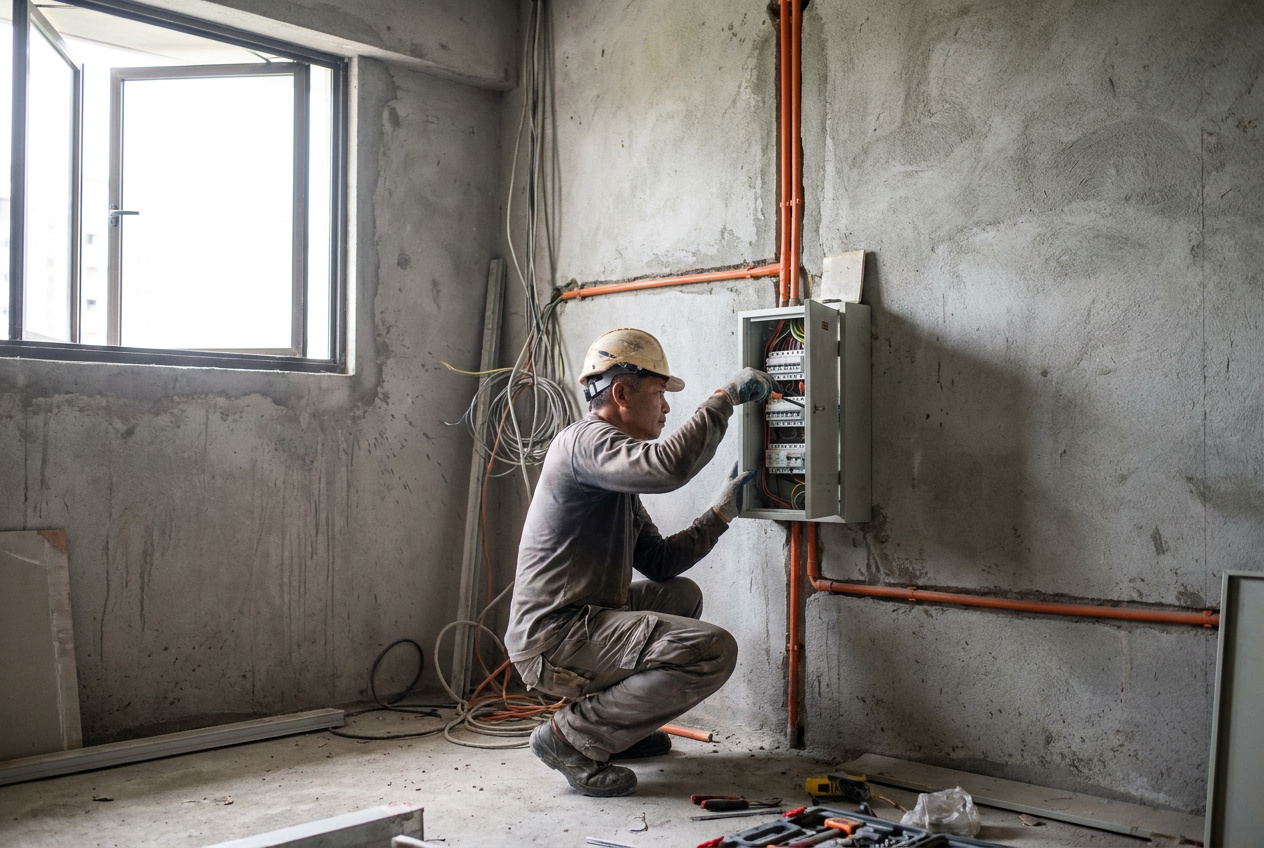
Renovating your HDB flat? Electrical permits feel like dull admin right up until the moment they hold up your whole timeline. Once you understand what needs approval, who files it, and how long each step takes, you can plan a renovation that moves without nasty surprises.
We will walk you through the permit process for HDB renovation owners: what needs declaring, how the steps fit together, and the slip-ups that trip people up.
What electrical work needs HDB approval
HDB treats electrical work as one part of your overall renovation permit. In most cases there is no standalone electrical permit; your electrical scope simply rides inside the renovation permit application.
Work usually handled inside the standard renovation permit, declared within the overall scope:
- Adding or shifting power points on existing circuits
- Rewiring the flat, whether full or partial
- Fitting new light fittings and ceiling fans
- Swapping an ELCB for an RCCB
One note: replacing the DB box (even a like-for-like swap) and adding new dedicated circuits for appliances should be spelled out in the APEX application, not quietly assumed. Your LEW and DRC contractor will normally flag these in the submission.
Work that needs extra attention in the application:
- Moving the DB box to a new position
- Upgrading the main switch capacity
- Changes to the incoming supply, coordinated with SP Group
- Hacking walls that hold concealed wiring (must be declared)
Work that involves SP Group on its own:
- Going from single-phase to three-phase supply
- Raising your supply capacity above the current allocation
- Any change to the meter or incoming supply cable
For most everyday HDB renovations, the electrical work slots neatly into the renovation permit. The cases that call for extra care are the ones touching the supply or relocating the DB box.
How to apply for HDB electrical permits
The HDB renovation permit carries your electrical work as part of the wider scope. Here is how it flows.
Step 1: Plan the electrical scope with your electrician. Before anyone applies, lock down the electrical plan with your electrician or interior designer. Decide where you want power points, where the lights go, whether the DB box needs replacing, and whether any supply upgrade is on the cards.
Step 2: Submit the renovation application. The renovation permit must be filed by a contractor on HDB's Directory of Renovation Contractors (DRC). It goes through APEX (Application for Renovation Permit via Electronic Transaction) on HDB InfoWEB. Homeowners and interior designers cannot submit directly unless the ID's firm is also DRC-registered. In practice, your DRC-registered main contractor files on your behalf.
The application sets out the full scope across all trades including electrical, the contractor's details, the estimated start and end dates, and an acknowledgement of HDB's renovation guidelines and permitted hours.
Step 3: Receive the renovation permit. Standard applications usually clear within a few working days, though HDB advises allowing up to 3 weeks. Simple cases can come back faster. The permit confirms the approved scope, the permitted hours, and your renovation period.
Permitted renovation hours in HDB flats are:
- General renovation work: 9am to 6pm, Monday to Saturday
- Noisy work (hacking, drilling, tile cutting, demolition): 9am to 5pm, Monday to Friday only, with no noisy work on Saturdays, Sundays, or public holidays
Do not mix up the two. When your electrician is chasing walls, hacking for concealed wiring, or cutting into walls, that falls under the noisy work limits.
Step 4: If SP Group coordination is needed. For supply upgrades, your LEW files a separate application to SP Group (SP Services), usually using Form CS/5 with the CS/3H HDB landlord consent endorsement. The submission includes a single-line diagram (SLD) showing the proposed installation, the requested supply capacity, and LEW certification details. Check current processing timelines with SP Group, since they can shift.
Step 5: Complete the work and get it certified. Once the electrical work is done, your LEW tests the installation and issues a completion certificate. Residential HDB flats are served by an LEW and do not need a separate Electrical Installation Licence regardless of connected load. The 45 kVA threshold that triggers an Electrical Installation Licence applies to non-domestic premises (for example, commercial or industrial), not to domestic HDB flats.
Timeline and processing
Here is a realistic timeline for HDB renovation electrical permits and the approvals around them.
Plan electrical scope: 1 to 2 weeks, done before you apply.
HDB renovation permit: up to 3 weeks (simple cases may be quicker), filed via APEX by your DRC contractor.
SP Group supply application: typically several weeks, only if a supply upgrade is needed; confirm timing with SP Group.
Non-standard review: add 1 to 2 weeks for DB relocation or unusual scope.
Work period: around 3 to 5 days of electrical work, fitted inside the overall renovation timeline.
LEW testing and certification: about 1 day, after the electrical work is complete.
For a standard renovation with no supply upgrade, you can usually start within a week or two of the permit being submitted, depending on turnaround. Where SP Group coordination is involved, plan for roughly 4 to 6 weeks of lead time before electrical work begins, though real timelines vary.
Get your renovation application in early. Even if a few details are still loose, having the permit in motion saves you scrambling when the contractor is ready to start.
Working with your contractor on permits
The permit process runs smoothest when everyone knows their part: you, your interior designer or contractor, and your electrician.
Your role:
- Decide the renovation scope, meaning the electrical changes you actually want
- Engage a contractor on HDB's Directory of Renovation Contractors (DRC), since only DRC contractors can file the permit
- Make sure the application accurately describes the electrical work
- Understand the permitted hours and renovation rules
- Keep copies of the renovation permit and the LEW completion certificate
Your DRC main contractor's role:
- Submit the HDB renovation permit through APEX on HDB InfoWEB
- Coordinate the trades, including scheduling the electrician
- Keep all work within the approved scope
- Manage the timeline and tell you about any changes
Your interior designer's role, where one is involved:
- Design the scope and liaise between you and the main contractor
- File directly only if the ID's firm is DRC-registered; otherwise they work through a DRC-registered main contractor
Your electrician's role:
- Provide the technical details for the renovation application
- Handle SP Group applications (Form CS/5 with CS/3H endorsement) if supply upgrades are needed
- Carry out the electrical work to code
- Test the installation and issue LEW completion certification
- Manage any LEW-specific documentation
Communication between these parties matters. The most common cause of delay is a muddle over the electrical scope between the homeowner, the ID, and the electrician. Look over the electrical plan yourself and confirm it matches what you expect before the permit goes in.
Common permit mistakes to avoid
These come up again and again on HDB electrical projects.
Not declaring the full scope. If your permit says minor electrical work but you are actually replacing the whole DB box and running new circuits across the flat, the scope is misstated. Make sure the application reflects what is really being done.
Forgetting SP Group lead time. If your renovation needs a supply upgrade and you only apply to SP Group after the renovation permit clears, you leave a gap where your contractor waits on SP Group before the electrician can start. File the SP Group application (Form CS/5) in parallel with the renovation permit to close that gap.
Assuming the ID handles everything. Your interior designer runs the renovation, but may not fully grasp the electrical scope, especially on complex jobs. Have your electrician review the electrical portion of the application before it is submitted.
Starting before the permit is approved. It sounds obvious, yet it happens. Contractors sometimes begin demolition or hacking on the assumption the permit will come through. If the application hits a snag, you may need to stop, rectify, and absorb delays and possible penalties.
Not keeping documentation. When the work is done, hold on to your renovation permit, the LEW completion certificate, and any SP Group correspondence. These come in handy if you sell the flat, if a neighbour dispute arises, or if HDB asks you to show the work was compliant.
For a fuller picture of HDB electrical work requirements, including what is allowed and what needs approval, see our compliance guide.
Frequently Asked Questions
What electrical work requires HDB approval? Most electrical work during a renovation is declared inside your HDB renovation permit, not as a separate electrical permit. Items usually folded into the scope include adding power points, rewiring, and fitting new lights. Items you should call out specifically in the APEX application include DB box replacement or relocation, new dedicated circuits, supply capacity upgrades (coordinated with SP Group), and any hacking that touches concealed wiring. The renovation permit covers the overall scope, so standard residential work does not need its own electrical permit. Our HDB electrical work requirements article goes deeper.
How long does an HDB electrical permit take? Standard renovation permits usually clear within a few working days through APEX on HDB InfoWEB (allow up to 3 weeks). Simple cases can be quicker. If SP Group coordination is needed for a supply upgrade, allow several extra weeks and check current timelines with SP Group. Non-standard requests such as DB relocation or unusual scope can add 1 to 2 weeks. Apply early so you do not delay your renovation start.
Can my electrician handle the permit application? The HDB renovation permit can only be filed by a contractor on HDB's Directory of Renovation Contractors (DRC). Homeowners and interior designers cannot submit directly unless the ID's firm is DRC-registered. Your electrician supplies the technical detail for the electrical scope and separately handles SP Group applications (Form CS/5 with the CS/3H endorsement) if supply upgrades are needed. The LEW manages testing, certification, and post-completion paperwork. Our HDB residential LEW services include technical documentation and coordination support.
What happens if I do electrical work without HDB approval? HDB enforcement can mean written warnings, financial penalties, or stop-work orders. Under the Electricity Act, unlicensed work carries its own penalties. Insurance claims may be refused, and unapproved work can complicate a future sale. The standard permit process is straightforward, and the protection it gives outweighs the effort.
Do I need a permit for simple outlet additions? During a renovation, outlet additions sit under your renovation permit. For a standalone addition with no other renovation work, it depends on the method. Concealed wiring that needs wall hacking may trigger a permit. Surface-mounted outlets with trunking sit in a greyer area. Either way, the electrical work itself always needs an LEW, permit or not. Our electrical installation services include guidance on permits for each project.
Getting compliant
HDB electrical permits are not a hurdle; they are a framework that protects you and your neighbours. For standard residential electrical work the path is simple: fold it into your renovation permit, have an LEW do it, and keep the paperwork.
It gets more involved when supply upgrades go through SP Group. Build in the extra lead time, file applications in parallel, and coordinate early with your electrician. A little effort upfront saves weeks of delay during the renovation.
For renovation projects that need HDB residential LEW services, our team handles the technical documentation, testing, and certification while you and your ID focus on the design and project management.