Understanding Your HDB Circuit Breaker Box
A plain-English tour of the grey panel near your front door: what each switch does, how to read the layout, and when your DB box needs an upgrade.
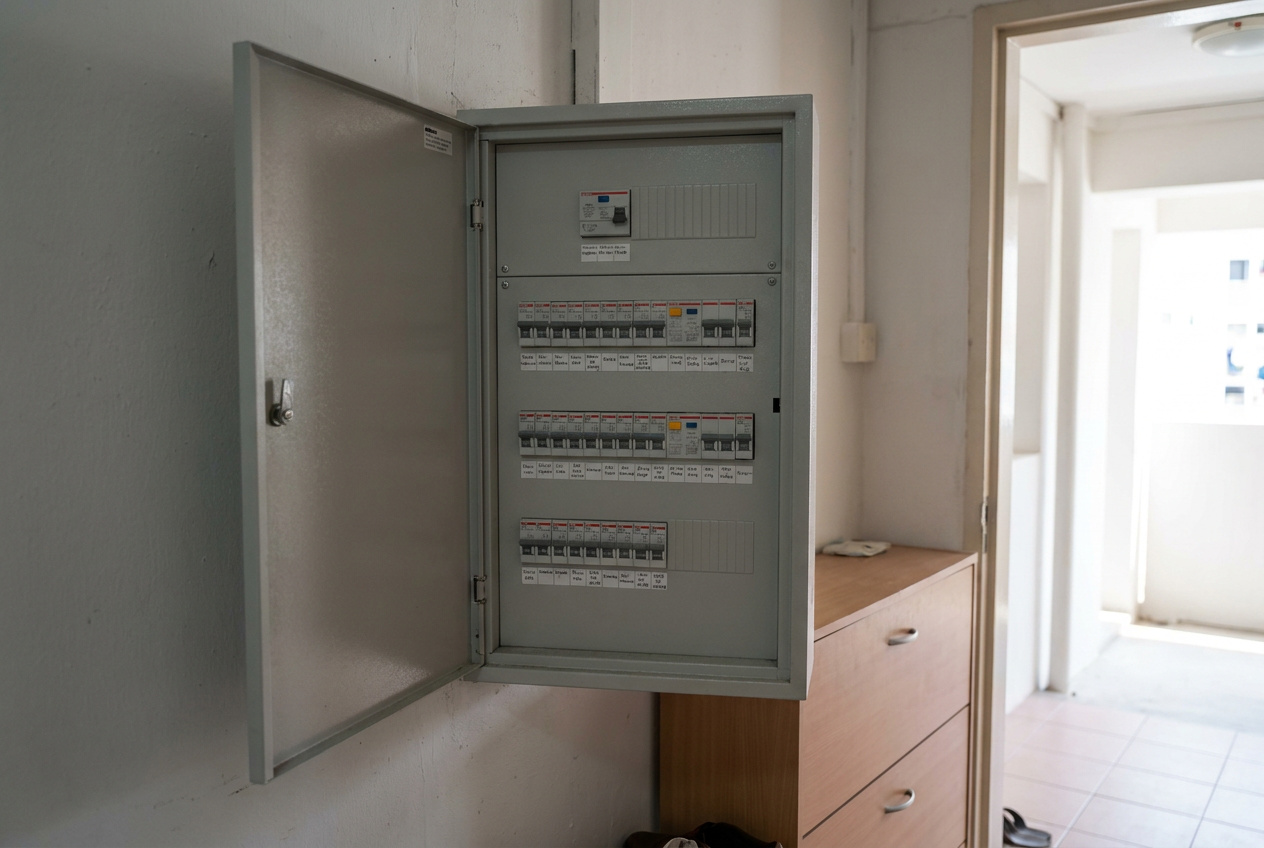
If you have ever opened that grey metal panel near your front door and wondered what all the switches do, you are not alone. Most HDB homeowners only think about the circuit breaker box when something goes wrong, but knowing how it works can save you time, stress, and sometimes money.
Your HDB circuit breaker box, also called the DB box (distribution board), is the control centre for your flat's whole electrical system. Every wire feeding your lights, sockets, and appliances passes through it. Grasp the basics and you can respond calmly to a power trip and talk clearly with your electrician.
What is inside an HDB circuit breaker box
Open the DB box and you will see a tidy set of switches and wiring. Here is what each part does.
Main switch: the large switch at the top of the board. Older flats often have a lower main-switch rating, while newer or upgraded blocks have higher loading; check your own DB box or ask your LEW. Higher ratings like 60A or 80A typically appear after a user-requested supply upgrade through SP Group. Flipping it cuts power to your whole flat, so you only use it in an emergency or when an electrician needs to work on the system.
RCCB or ELCB: directly below the main switch. This device watches for earth leakage, the kind of fault that can cause electric shock. If it senses current taking an unintended path (through a person or water, say), it cuts power within milliseconds. Modern HDB flats use RCCBs; older flats may still have ELCBs. If yours still has an ELCB, consider upgrading through our HDB ELCB service.
Neutral bar and earth bar: metal strips inside the box that gather all the neutral and earth wires from every circuit. They are not switches you touch, but they are essential for your system to work safely.
MCBs: the smaller switches
MCBs (Miniature Circuit Breakers) are the row of smaller switches below the RCCB. Each one protects a specific circuit in your flat. Common circuits include:
When a circuit overloads or develops a fault, the MCB for that circuit trips, cutting power only to that circuit while the rest of your flat stays on.
- Lighting circuit (usually 6A or 10A).
- General power socket circuit (16A or 20A).
- Air conditioning circuit (20A).
- Water heater circuit (20A or 32A).
- Kitchen appliance circuit (20A or 32A).
Reading your HDB circuit breaker diagram
Most DB boxes have a label card inside the cover door listing which MCB controls which circuit. If yours is missing or unreadable, it is worth making one.
To map your circuits, switch off one MCB at a time and see which lights or sockets lose power. Label each one clearly: "Master bedroom sockets", "Kitchen lights", "Aircon", and so on. It takes about 20 minutes and is genuinely useful when you need to isolate a problem fast.
The card also shows each MCB's amperage. If your kitchen socket circuit runs on a 16A breaker but you have added several high-power appliances since moving in, that could explain frequent tripping. A qualified electrician can advise whether to upgrade that circuit's MCB or split it into two circuits.
Common HDB DB box configurations by era
HDB flats from different decades have noticeably different setups.
- 1980s to 1990s flats: often older-style DB boxes with fewer circuits, typically 6 to 8 ways. Some still use rewirable fuses rather than MCBs. Earth leakage protection, if present, is usually an older ELCB type, and the wiring insulation may be degrading, so professional inspection matters here.
- 2000s to 2010s flats: generally modern MCB-based DB boxes with 10 to 12 ways. RCCBs became more common in this period. Capacity is better matched to modern appliances, though early-2000s flats may still struggle if many high-power devices run at once.
- Recent BTO flats: current BTO flats come with 12 to 16-way DB boxes, RCCB protection as standard, and circuits built for modern living, usually with dedicated runs for air conditioning, water heaters, and kitchen appliances, plus spare ways for future additions.
When to upgrade your HDB circuit breaker box
Not every electrical issue means a new DB box, but there are clear cases where an upgrade makes sense.
- Age: if your DB box is over 20 years old and has never been serviced, the internal parts may no longer protect reliably. Contacts corrode, connections loosen, and plastic turns brittle in Singapore's humidity.
- Frequent tripping: occasional trips are normal, especially with a faulty appliance. But if your MCBs or RCCB trip regularly for no obvious reason, the breakers may be worn out.
- Renovation: adding circuits for an induction hob, built-in oven, washer-dryer, or other high-power appliances may exceed your existing DB box's capacity. This is the most cost-effective time to upgrade, since the electrician is already on site.
- No earth leakage protection: a flat without an RCCB or ELCB lacks a critical safety feature. RCCB protection has been mandatory for new builds since July 1985. Under EMA's 2023 regulation, all pre-1985 homes (HDB, condo, landed) must retrofit an RCCB by 1 July 2025, with non-compliance attracting fines up to S$5,000. Subsidies are available: 100 percent for eligible 1-2 room HDB flats and up to 95 percent for 3-room and larger flats built before 1985.
- Visible damage: burn marks, scorch marks, melted plastic, or a lasting electrical smell around the DB box all point to serious problems. Do not ignore these; call an electrician promptly.
Cost of HDB DB box replacement
DB box replacement costs in Singapore vary with flat size and requirements.
For a standard 3-room or 4-room HDB flat, expect S$350 to S$800. This usually covers the new distribution board, MCBs, RCCB, labour, and post-installation testing. Larger flats or those needing extra circuits cost more.
Always ask for an itemised quote before agreeing to the work. A reputable electrician will assess your flat, explain what is needed, and price it clearly without hidden charges.
- Number of circuits: more MCBs means a larger, pricier DB box.
- Type of protection: adding surge protection or a higher-rated RCCB raises the cost.
- Wiring condition: if existing wiring needs repair or rerouting, expect extra charges.
- Accessibility: an awkward DB box location that makes installation difficult can add labour cost.
How much does HDB DB box replacement cost?
Replacing an HDB DB box in Singapore typically runs S$350 to S$800, depending on the number of circuits and the protection devices fitted. A basic replacement for a standard 3-room flat with 6 to 8 circuits sits at the lower end. Larger flats with 10 or more circuits, or those needing extra RCCB protection, cost more.
The price usually covers the new board, MCBs, an RCCB or ELCB, labour, and testing. If your wiring needs repair or rerouting during the work, that adds to the total. Some older flats have non-standard setups that need extra work to meet current standards.
Always ask for an itemised quote before work starts, and remember the work must be done by a Licensed Electrical Worker (LEW) who can certify it meets EMA regulations. This is the central safety hub for your whole flat, so cutting corners is not worth the risk.
When should I upgrade my HDB circuit breaker box?
Several signs point to an upgrade. If your flat was built before 2000 and the DB box has never been replaced, the parts may be near the end of their reliable life. Frequent tripping that is not down to one faulty appliance is another strong signal.
Burn marks, a burning smell, or discolouration anywhere on the DB box should be treated as urgent. A major renovation is also a good moment to upgrade, especially if you are adding circuits for an induction hob, built-in oven, or electric vehicle charger.
Flats still using older fuse-wire boards instead of MCBs should upgrade as soon as practical, since fuses give far less precise protection. And if your DB box has no RCCB, upgrading is essential: under EMA's 2023 regulation, pre-1985 homes must retrofit an RCCB by 1 July 2025, with fines up to S$5,000 for non-compliance. Eligible pre-1985 HDB flats can tap subsidies (100 percent for 1-2 room flats, up to 95 percent for 3-room and larger).
What components are inside an HDB DB box?
A standard HDB distribution board has a few key parts working together. At the top is the main switch, which controls power to your whole flat. Below it is the RCCB (or ELCB), which watches for earth leakage current and cuts power if it senses a fault that could cause shock.
The individual circuit breakers, the MCBs, each protect one circuit, such as lighting, power sockets, or air conditioning. They come in ratings of typically 6A, 10A, 16A, 20A, or 32A, matched to each circuit's load.
Inside you will also find the neutral bar and earth bar, where all the neutral and earth wires meet. Some newer HDB boxes also include surge protection. Knowing these parts helps you spot which breaker tripped and explain it clearly to your electrician.
Do I need a LEW to replace my DB box?
Yes. Replacing a DB box in Singapore must be done by a Licensed Electrical Worker (LEW). Under the Electricity Act and its subsidiary regulations, any electrical installation work, including distribution board replacement, needs a licensed professional. This is both a legal and a safety requirement.
The work means handling live connections and making sure every circuit is correctly wired, properly rated, and safely terminated. An LEW also tests the installation afterwards, checking insulation resistance, earth continuity, and RCCB trip times, then provides certification that it is safe and compliant.
For HDB flats, HDB may require the LEW to submit documentation for certain work. A DIY DB box replacement is both illegal and dangerous: if something goes wrong, your insurance may not cover the damage, and you could face penalties. Our HDB residential LEW service covers the whole process from assessment to certification.
What is the lifespan of an HDB circuit breaker box?
Most HDB circuit breaker boxes have a practical life of 20 to 25 years, though individual parts may need attention sooner. MCBs are rated for a certain number of operations, typically around 10,000 switching cycles under normal use, but power surges, repeated tripping, and humidity can shorten that.
The RCCB or ELCB has a similar lifespan but should be tested regularly with the built-in test button to confirm it still trips. The enclosure itself can last longer, but internal busbars and terminals may corrode or loosen over time, especially in Singapore's humid climate.
If your DB box is older than 15 years, a professional inspection is worth it. Signs of ageing include slight discolouration of the plastic, warm spots near terminals, or a faint electrical smell. Even if nothing seems wrong, replacing an ageing DB box during a renovation can spare you an unexpected failure later.
Can I add more circuits to my existing DB box?
It depends on your current DB box's capacity. Most modern HDB boards come with a few spare slots (ways) for future expansion. A typical 4-room flat might have a 12-way or 16-way DB box with 2 to 4 spare ways.
If you have spare ways, adding a circuit is fairly simple: your electrician fits a new MCB in the spare slot, runs wiring to the new spot, and tests it. There are limits, though. The total load across all circuits must not exceed the rating of the main switch and the incoming supply cable.
Adding heavy loads like an EV charger may require upgrading the main switch or applying to SP Group for more supply capacity. If your DB box has no spare ways, you can either replace it with a larger one or add a secondary sub-board. Both need a Licensed Electrical Worker. Have an electrician assess your setup before planning any additions.
Keeping your DB box in good shape
Your HDB circuit breaker box does not need much attention, but a little awareness goes a long way.
Test your RCCB monthly by pressing the test button; it should trip straight away. If it does not, get an electrician to check it. Keep the area around the box clear and reachable so you can get to it fast in an emergency. If you notice anything odd, like warmth, strange sounds, or a faint smell, do not ignore it.
For flats older than 15 years, consider a professional troubleshooting inspection of your DB box and wiring. It is a small investment next to the cost and disruption of an unexpected failure. Your DB box is the heart of your flat's electrical system, and understanding it puts you in a much better position to keep your home safe and your power steady.