
Ceiling Fan Installation: What an Electrician Does
What a licensed electrician actually does when installing a ceiling fan in a Singapore home: bracket, wiring, controls, safety checks and costs.
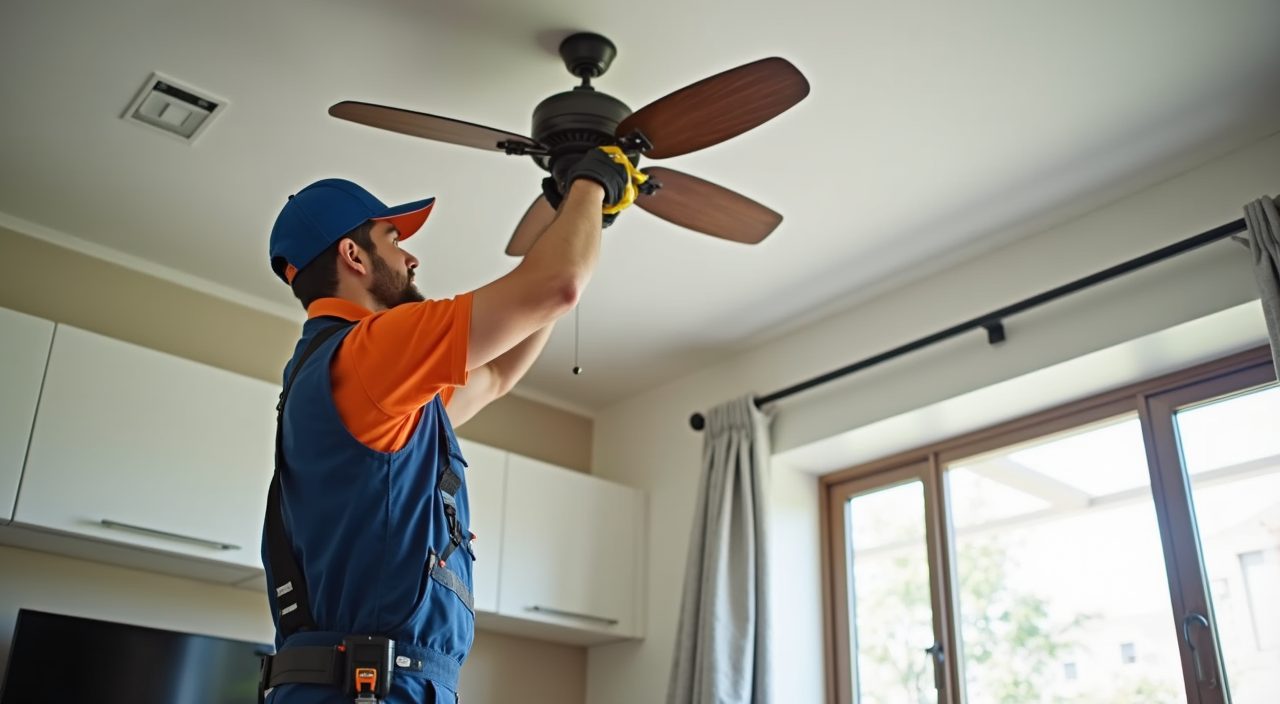
A ceiling fan installation involves mounting a secure ceiling bracket, connecting the fan to the mains wiring, fitting the wall switch or remote receiver, and testing the fan across all speeds for wobble and correct rotation. In Singapore this is electrical work, so it should be done by a competent installer, and any new wiring point or circuit change ideally involves a Licensed Electrical Worker (LEW) to stay compliant.
The job sounds simple, but a fan is a heavy spinning load hanging over your head, often above a bed or dining table. Getting the mounting, balancing and wiring right is what separates a quiet fan that lasts years from one that wobbles, hums, or trips your circuit. Here is exactly what a proper installer does from start to finish.
What does a ceiling fan installation actually involve?
The core steps are broadly the same whether it is a HDB flat, condo, or landed home, though the ceiling type changes the method. A good installer works through them in order and does not skip the testing.
Rushing any single step is where problems start, so a careful installer treats each one as its own checkpoint before moving on.
- Turn off power at the distribution board (DB) and confirm the circuit is dead before touching any wiring.
- Fix a fan mounting bracket rated for the fan's weight into a solid part of the ceiling.
- Connect the fan's live, neutral and earth wires to the ceiling point and check polarity.
- Fit and balance the blades, then attach the canopy that hides the wiring.
- Install the wall regulator, switch, or remote receiver that controls the fan.
- Power up and test every speed, checking for wobble, hum, and correct direction.
Why does the ceiling type matter so much?
The single biggest variable in a Singapore fan install is what the fan hangs from. A false ceiling made of plasterboard or gypsum cannot hold a spinning fan on its own, so the installer must anchor the bracket to the concrete slab above or to a proper support beam, then run a drop rod down through the false ceiling.
Concrete slab ceilings, common in older HDB flats, are strong but require drilling and the right anchors. If your fan location has no existing electrical point, that is a bigger job: a new wiring point has to be run from a suitable circuit, which is where a Licensed Electrical Worker becomes important for a safe and compliant result.
Do I need a licensed electrician in Singapore?
For a straightforward swap where an existing fan point already exists, a skilled handyman or contractor can often do the mounting and reconnection. The moment new wiring, a new point, or any change at the distribution board is involved, the work falls under regulated electrical work and should be handled by a Licensed Electrical Worker.
Using a competent, insured installer also protects you if something goes wrong later. A fan that falls or wiring that overheats is not the place to save a few dollars, especially in a rented or strata property where you may be liable for damage.
How long does it take and what does it cost?
A simple replacement at an existing point usually takes under an hour. A fresh installation with a new point, false-ceiling support, or a smart or DC remote fan can take a few hours, sometimes with two people for the heavier models.
Costs in Singapore vary with the type of fan, ceiling, and whether new wiring is needed, so treat any figure as a range rather than a fixed price. Expect a modest labour fee for a straight swap, and a higher amount when a new point, extended drop rod, or additional switching is required. Always ask for the price to be confirmed after the installer sees the actual site.
- Straight replacement at an existing point: lowest cost, quickest job.
- New fan point with fresh wiring: higher, because of cabling and DB work.
- False-ceiling installs and long drop rods: extra for support and access.
- DC, smart, or remote fans: sometimes more for receiver setup and testing.
How do I get a ceiling fan installed properly?
The cleanest path is to have a qualified electrical team look at your ceiling, confirm whether a new point is needed, and quote before starting. Our ceiling fan installation service covers mounting, wiring, controls and full testing, and we bring in a Licensed Electrical Worker where new points or board work are involved.
When you book, tell the installer the fan brand and size, the ceiling type (concrete or false ceiling), and whether a fan point already exists at that spot. That information alone lets us give a far more accurate quote and bring the right anchors and tools on the first visit.
What should I check after the fan is installed?
Before the installer leaves, run the fan through every speed and watch it for a minute. A well-balanced fan should spin smoothly with only a faint air noise, no visible wobble, and no rhythmic clicking or humming.
Also confirm the direction is correct for the season you want, that the remote or wall control switches all speeds cleanly, and that nothing on that circuit trips when the fan runs alongside your lights or air conditioner.
- No wobble at the highest speed.
- No grinding, ticking, or loud electrical hum.
- All speeds and the light kit (if fitted) respond to the control.
- The circuit does not trip under normal combined load.
Frequently asked questions
Can I install a ceiling fan myself in Singapore? You can physically do a like-for-like swap at an existing point if you are confident and switch off the power first, but any new wiring, new point, or distribution board change is regulated electrical work that should be done by a Licensed Electrical Worker. If in doubt, get a professional to do it.
Can a ceiling fan be installed on a false ceiling? Yes, but not on the plasterboard alone. The bracket must be anchored to the concrete slab or a support beam above, with a drop rod run down through the false ceiling, so the fan's weight is never carried by the gypsum board.
Why is my ceiling fan wobbling? Common causes are an unbalanced blade set, a loose bracket or canopy, blades that are slightly bent, or a mount that is not fully tightened to a solid surface. A wobble that appears after installation usually means the mounting or balancing needs to be redone rather than the fan being faulty.
Do I need a new electrical point for a ceiling fan? Only if there is no existing fan or lighting point where you want the fan. If there is a suitable point already, the installer can often connect to it. If not, a new point has to be wired from an appropriate circuit, which is a larger job best done with a Licensed Electrical Worker.