
Installing a Home EV Charger in Singapore: Load, Wiring and DB Box Requirements
A Singapore homeowner's guide to home EV charger installation: spare load, dedicated wiring, DB box space, RCBO protection and who can legally do the work.
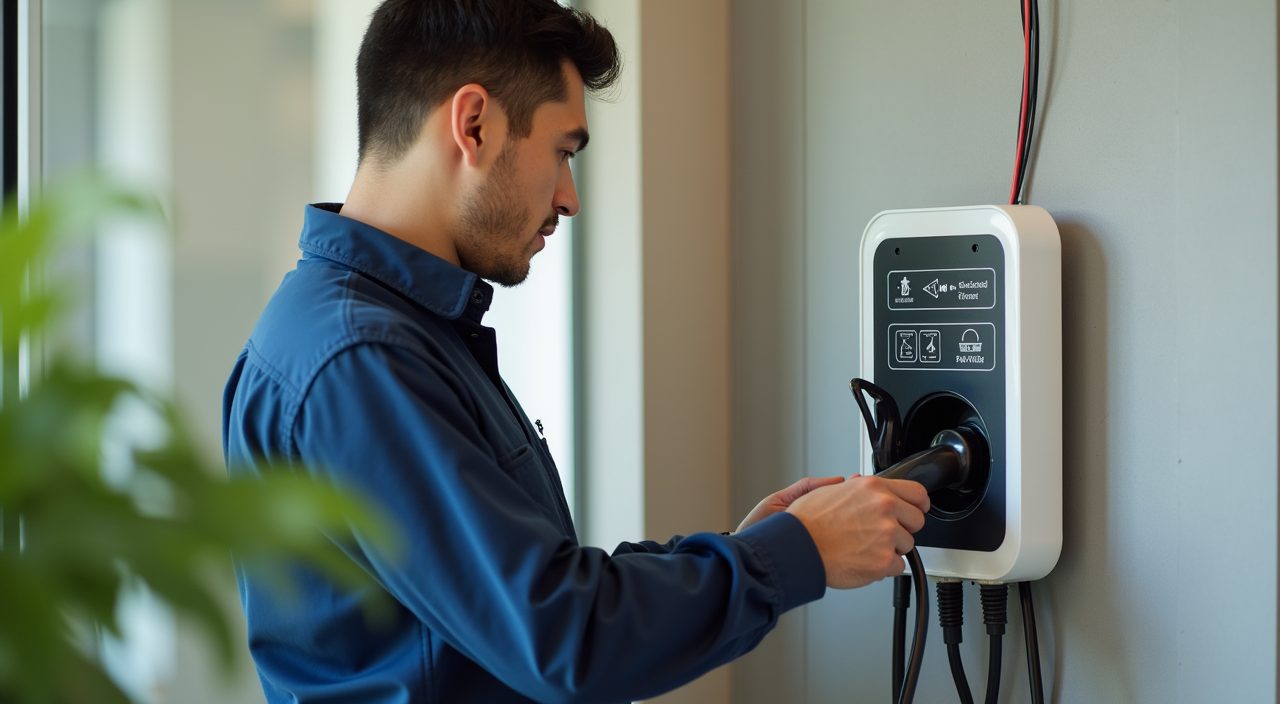
Installing a home EV charger in Singapore means running a dedicated circuit from your distribution board (DB box) to the charge point, protecting it with the right breaker and residual current device, and confirming your supply has spare capacity for the extra load. For most landed homes and some condos, a 7.4kW single-phase charger is the common choice, and the work must be carried out or endorsed by a Licensed Electrical Worker (LEW). The charger itself is only part of the job; the wiring, protection and load headroom around it are what make it safe and compliant.
A typical 7.4kW charger draws about 32A continuously, which is a heavy, sustained load compared with normal household appliances. That is why you cannot simply plug into an existing socket. This guide walks through load checks, cabling, DB box requirements and the approvals you need before an EV charger goes live at home in Singapore.
Can my home supply handle an EV charger?
It depends on your existing supply and how much of it is already used. Most Singapore landed homes have a single-phase supply rated at 60A or above, and many newer or larger homes have a three-phase supply. A 7.4kW charger adds roughly 32A of sustained draw, so the question is whether your main fuse and DB box have that headroom on top of aircon, water heaters, oven and everything else running at once.
If your spare capacity is tight, you have options rather than a dead end. A load management device can throttle the charger when other heavy appliances switch on, and a supply upgrade through SP Group is possible if you genuinely need more capacity.
- Single-phase 7.4kW charger: about 32A continuous, suits most homes
- Three-phase 11kW or 22kW charger: faster, needs three-phase supply and more spare load
- Load-managed setups let a charger share capacity with the rest of the house
- A Licensed Electrical Worker should confirm your actual spare load before you buy
What wiring does an EV charger need?
An EV charger needs its own dedicated circuit run directly from the DB box to the charge point, not a spur off an existing socket ring. The cable is sized for the charger's continuous current with an allowance for the run length, so a 7.4kW charger commonly uses cable in the region of 6mm to 10mm cross-section depending on distance and installation method. Longer runs to a car porch or basement carpark need a larger cable to keep voltage drop within limits.
The route matters as much as the cable size. Cable run outdoors or through a garden needs proper mechanical protection and correct rating for the environment, and the final connection at the charger must use a suitable weatherproof enclosure if it sits outside.
What DB box changes are required?
Your distribution board needs a spare way (an empty slot) for the charger's protective device, or space to add a small sub-board if it is full. The charger circuit is typically protected by an RCBO or by an MCB paired with a Type A or Type B residual current device, because EV charging can produce DC residual currents that ordinary Type AC devices do not detect reliably.
If your DB box is old, full, or lacks the right earthing arrangement, part of the job may be tidying or upgrading it. This is normal and it is one reason an EV charger install is more involved than fitting a new socket.
- A free way in the DB box, or a new sub-board if it is full
- RCBO, or MCB plus a Type A or Type B RCD suited to EV charging
- Correct earthing and, for some setups, an earth electrode or PEN fault protection
- A clearly labelled circuit so the charger is easy to isolate
Do I need approval, and who can do the work?
Fixed electrical work in Singapore must be carried out or supervised and endorsed by a Licensed Electrical Worker. For a home EV charger you should engage an electrician or contractor who works with an LEW, and for anything that touches your main supply, the LEW handles the notification and connection side with SP Group. Condo and strata installs also need management corporation (MCST) approval and often use a shared or managed charging system in the carpark.
Getting a licensed electrician to handle the load check, dedicated wiring and DB box work is the safe route, and it is exactly the kind of electrical work our team takes on for Singapore homes. Doing it properly the first time avoids nuisance tripping, overheating cable and a charger that fails inspection.
How much does home EV charger installation cost?
The charger hardware and the installation are two separate costs, and the install can swing widely based on your home. A wall-mounted 7.4kW charger unit is a few hundred to well over a thousand dollars depending on brand and smart features, while installation depends heavily on cable run length, DB box condition and whether any supply upgrade is needed.
Short cable runs into an existing, well-equipped DB box are the cheapest. Long runs, trenching across a driveway, a full DB box, or a supply upgrade all push the price up, so the honest answer is that a site assessment gives you a real number rather than a guess.
- Charger unit: varies by brand, power rating and smart features
- Cable and containment: driven by run length and route
- DB box work: adding protection, or upgrading a full or old board
- Supply upgrade: only if your spare load is genuinely insufficient
Frequently asked questions
Can I just plug my EV into a normal wall socket? You can trickle charge from a standard socket with the cable that came with the car, but it is slow and a normal socket is not designed for many hours of sustained high load, so it is not a safe long-term solution. A dedicated charger on its own circuit is the proper setup for regular home charging.
Do I need a three-phase supply for a home charger? No. A single-phase 7.4kW charger suits most Singapore homes and fully charges most cars overnight. You only need three-phase if you want an 11kW or 22kW charger and your supply already provides three phases.
How long does the installation take? A straightforward install is often done within a day once the charger and materials are on site. Longer cable runs, DB box upgrades or a supply upgrade through SP Group add time, which is why a site assessment first is worthwhile.
Can I install an EV charger in my condo carpark? Usually yes, but it needs MCST approval and often a managed or shared charging system, since carpark supply and billing are shared. Speak to your management first, then have a licensed electrician assess the available supply and routing.