
Solid Surface Countertops: When Corian-Style Tops Make Sense in Singapore
A Singapore homeowner's guide to solid surface countertops: what Corian-style tops are, where they beat quartz and sintered stone, and where they fall short.
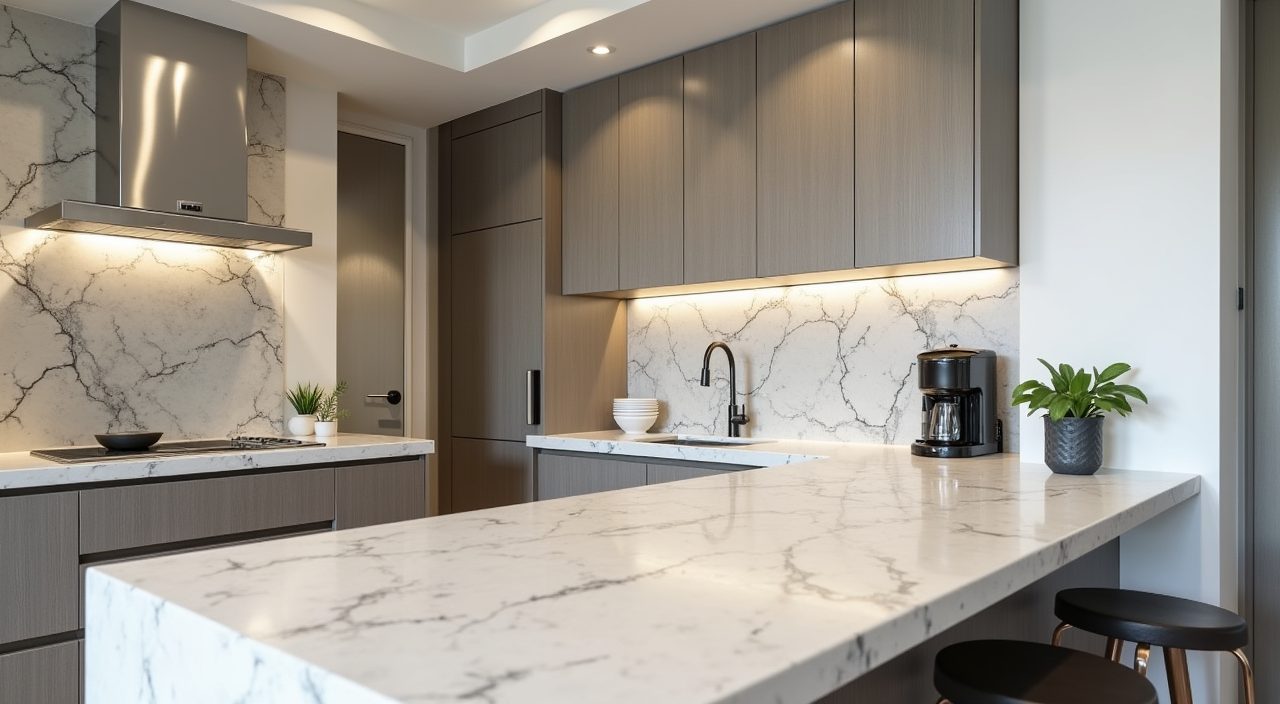
A solid surface countertop is a man-made sheet material blended from acrylic or polyester resin and mineral fillers, moulded into a seamless top. Corian is the best-known brand, so many Singapore homeowners simply call the whole category "Corian-style". It makes the most sense when you want a fully seamless, non-porous, easily repairable surface and are willing to accept lower heat and scratch resistance than quartz or sintered stone.
In Singapore homes, solid surface shows up most often on bathroom vanities, laundry-yard counters, feature ledges, and softer-use kitchen worktops. It is a middle-tier choice: usually pricier than laminate but often cheaper than good quartz or sintered stone. The right question is not "is it good" but "does its trade-off profile match how you actually use the counter".
What exactly is a solid surface countertop?
Solid surface is a homogeneous composite, meaning the colour and pattern run all the way through the slab, not just on a printed top layer. It is typically about one-third acrylic or polyester resin and two-thirds natural mineral filler such as alumina trihydrate. Sheets are usually 6mm to 12mm thick and are built up or edge-laminated to look like a thicker top.
The defining trait is that pieces are joined with a colour-matched adhesive and sanded flush, so seams effectively disappear. That is why sinks, drainboards, and coved backsplashes can be fused into one continuous run with no visible grout line or joint to trap grime.
- Made from acrylic or polyester resin plus mineral filler
- Colour and pattern go right through the material
- Non-porous, so it does not need sealing
- Seams are glued and sanded to look invisible
- Common brands: Corian, Staron, Hanex, LG HI-MACS, Hyundai
How does solid surface compare to quartz and sintered stone?
The three materials Singapore homeowners weigh most often are solid surface, engineered quartz, and sintered stone (porcelain slab). They sit at different points on the hardness, heat, and price scale. Solid surface is the softest and most repairable; sintered stone is the hardest and most heat-tolerant; quartz sits in between.
A quick way to decide: if you cook heavily with hot pans and sharp knives on bare stone, lean stone. If you value a seamless look, easy on-site repairs, and integrated sinks, solid surface earns its place.
- Heat resistance: sintered stone highest, then quartz, then solid surface lowest (a hot pot can mark or scorch solid surface)
- Scratch resistance: sintered stone and quartz clearly harder; solid surface scratches more easily but sands out
- Repairability: solid surface wins, minor scratches and even burns can be sanded and polished on site
- Seamlessness: solid surface is best for invisible joints and integrated sinks
- Stains: all three resist stains well; solid surface and quartz are non-porous, sintered stone is essentially impervious
- Price: laminate cheapest, then usually solid surface, then quartz, then sintered stone at the top
Where does solid surface make the most sense in a Singapore home?
Solid surface shines in wet, splashy, moderate-use areas rather than as a heavy-duty chopping and searing surface. Its non-porous body and seamless joints make it very hygienic and easy to wipe down, which suits humid Singapore conditions where mould loves grout lines and gaps.
It is a strong pick for bathroom vanity tops, powder-room counters, laundry and service-yard counters, reception or study ledges, and light-use kitchen worktops in homes that cook gently or eat out often. For a hard-searing home cook, it is usually the wrong tool.
- Bathroom and vanity tops with integrated undermount basins
- Laundry and service-yard counters that get wet often
- Curved or custom-shaped feature ledges and reception counters
- Light-cooking kitchen worktops where a seamless look matters
- Homes with young children or elderly, where softer edges and easy hygiene help
What are the real downsides you should plan for?
The honest weaknesses are heat and abrasion. Placing a hot pot straight from the stove onto solid surface can leave a scorch mark or even a crack from thermal shock, so trivets are not optional. It also scratches more readily than stone, though most scratches buff out.
The upside of those weaknesses is forgiveness. Because the material is solid through and non-porous, a professional can sand out scratches, light burns, and dull patches and re-polish the surface back to near-new, something you cannot easily do with quartz or a chipped sintered edge.
- Not heat-proof: always use trivets and pot stands
- Scratches more easily than quartz or porcelain
- Can dull over time in high-traffic zones, though it re-polishes
- Very dark and very glossy colours show fine scratches and swirl marks most
- Cheaper polyester-based sheets are more brittle than acrylic-based ones
How much do solid surface countertops cost in Singapore?
Pricing depends on brand, colour, thickness, edge detail, and how much fabrication (sink cut-outs, coving, curves) is involved, so treat any figure as a range rather than a fixed quote. As a rough guide, solid surface commonly lands between laminate and quartz on a per-foot-run or per-square-foot basis, with premium acrylic brands and complex shapes pushing the price up toward quartz territory.
Cheaper polyester blends and plain colours cost less; branded acrylic material, thick built-up edges, integrated basins, and seamless waterfall ends cost more. Because prices move with material choice and workmanship, the sensible step is to get an itemised quote for your exact layout rather than rely on a headline number.
How is solid surface installed and maintained?
Installation is a fabrication job: the installer templates your cabinets, cuts the sheet, glues and sands the seams, builds up the edges, and bonds any integrated sink. Good preparation of level, well-braced cabinet carcasses matters, because a seamless top only looks flawless on a true, flat base. If you want the counters done as part of a wider kitchen or bathroom renovation, it is worth having your renovation contractor coordinate the countertop fabrication, plumbing tie-in, and any electrical points for hobs and sockets so everything lines up on one schedule.
Day to day, care is simple. Wipe with a soft cloth and mild detergent or a diluted household cleaner, avoid abrasive scouring pads on glossy finishes, and never rest hot cookware directly on the surface. For deeper scuffs, a light sanding and re-polish by a professional restores the finish.
- Cabinets must be level and well braced before templating
- Seams are glued and sanded on site for an invisible finish
- Clean with mild detergent and a soft cloth; skip harsh abrasives on gloss
- Use trivets for hot pans, always
- Book a professional buff-and-polish every few years for high-use tops
Frequently asked questions
Is Corian the same as solid surface? Corian is a specific brand of solid surface made by DuPont. Solid surface is the general material category, and other brands such as Staron, Hanex, LG HI-MACS, and Hyundai are all solid surface too, so "Corian-style" is just shorthand for the type.
Can I put a hot pan on a solid surface counter? No. Direct heat can scorch, discolour, or crack solid surface through thermal shock. Always use a trivet or pot stand, and let very hot cookware cool slightly before it touches the top.
Does solid surface stain in a Singapore kitchen? It resists staining well because it is non-porous, so soy sauce, coffee, turmeric, and curry usually wipe off if cleaned reasonably soon. Prolonged contact with strong dyes or harsh chemicals can leave marks, but most can be buffed out.
Is solid surface a good choice for a heavy-cooking home? Not as the main worktop. If you sear on cast iron and chop directly on the counter daily, quartz or sintered stone handles the abuse better. Solid surface suits light-cooking kitchens, vanities, and wet counters where its seamless, hygienic, repairable qualities count most.