
How to Change an LED Ceiling Light (Safely)
A safe, Singapore-specific guide to changing an LED ceiling light: turn off power at the DB, test before touching, and know when to call a licensed electrician.
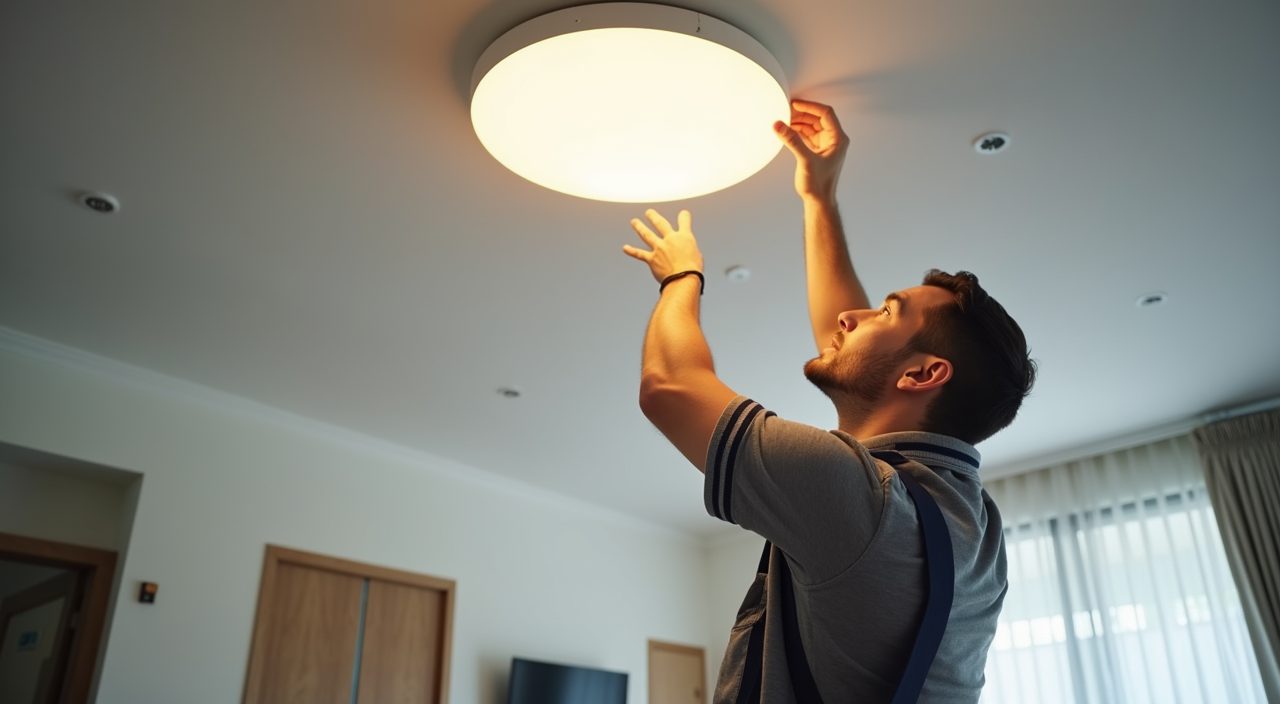
To change an LED ceiling light safely, switch off the circuit at your distribution board (the DB box), confirm the light is dead with a voltage tester, then remove the old fitting, connect the new one to the same live, neutral and earth terminals, and mount it before restoring power. The job is straightforward for a simple bulb or a plug-and-play fitting, but any hard-wired work should be done with the power fully isolated, not just the wall switch flicked off.
In Singapore, most ceiling lights are wired directly into the circuit rather than plugged in, so the safe method depends on what you are actually replacing. Swapping a lamp in an existing fitting is a light DIY task. Replacing the whole fitting, changing a downlight, or dealing with old or damaged wiring moves into territory where a Licensed Electrical Worker is the sensible and, in some cases, legally required choice.
What are you actually replacing?
Before you touch anything, be clear about the type of job, because the risk level is very different for each. Many homeowners say "change the light" when they only need a new bulb, while others mean a full fixture swap that involves live wiring.
Match your situation to one of the categories below so you pick the right approach and the right level of caution.
- Replacing a bulb or LED lamp in an existing fitting: usually low risk and DIY-friendly.
- Swapping a complete ceiling fitting that is hard-wired: involves live conductors and should be done with power isolated at the DB.
- Changing recessed downlights or an integrated LED panel: often needs a matching driver and correct sizing, and is easy to get wrong.
- Any fitting with signs of scorching, loose wires, or a tripping circuit: stop and get a licensed electrician.
How do you turn off the power safely?
Flicking the wall switch off is not enough on its own, because the switch may only break one conductor and the fitting can still be live. The safe step is to isolate the correct circuit at your distribution board, which is the panel of switches usually near your main door or in a service area.
Turn off the miniature circuit breaker (MCB) that feeds the lighting circuit, or the main switch if you are unsure which one it is. Then test the fitting with a non-contact voltage tester or a proper multimeter before you touch any wires. If you cannot confirm the circuit is dead, do not proceed.
- Open the DB and switch off the lighting MCB (or the main switch).
- Confirm the light no longer responds at the wall switch.
- Use a voltage tester at the fitting to verify it is dead.
- Keep the DB switched off for the whole job and tell others in the home not to switch it back on.
How do you remove the old fitting and fit the new one?
With the power isolated and tested, take a photo of the existing wiring before you disconnect anything. Singapore wiring commonly uses brown or red for live, blue or black for neutral, and green-yellow for earth, but older homes vary, so your photo is your reference for reconnecting.
Loosen the terminals or connector block, note which wire goes where, and remove the old fitting. Connect the new LED fitting to the same terminals: live to live, neutral to neutral, and earth to earth. Make sure connections are tight with no exposed copper, then secure the fitting to the ceiling before restoring power and testing.
- Photograph the wiring first so you can copy it exactly.
- Match live, neutral and earth to the same terminals on the new fitting.
- Ensure the new fitting's voltage and driver suit your supply (Singapore mains is 230V, 50Hz).
- Tighten all connections, tuck wires in neatly, then mount and test.
When should you call a licensed electrician instead?
Some jobs are best left to a professional, both for safety and because Singapore regulates electrical work. A Licensed Electrical Worker knows how to isolate circuits correctly, size the right driver, and leave the installation compliant. This matters most when the wiring is old, the circuit keeps tripping, or you are installing multiple downlights or an integrated panel.
If you would rather not open the DB or handle live conductors at all, professional lighting and LED installation is the safe route. A qualified electrician can supply and fit the correct fitting, confirm the earthing is sound, and make sure nothing overheats behind the ceiling.
- The circuit trips when the light is on, which suggests a fault.
- You see scorch marks, melted insulation, or smell burning.
- The ceiling is high, the fitting is heavy, or access is awkward.
- You are installing several downlights, a panel light, or new points rather than a like-for-like swap.
What tools and safety gear do you need?
You do not need much for a simple swap, but the right tools make the job safer and cleaner. The most important item is a reliable voltage tester, because everything else depends on confirming the power is truly off.
Work in good light, on a stable ladder, and never rush a connection just to get the light back on.
- Non-contact voltage tester or a multimeter.
- Insulated screwdrivers.
- A stable step ladder, ideally with someone footing it.
- The correct replacement fitting or LED lamp rated for 230V.
- Your phone to photograph the existing wiring.
How do you avoid common mistakes?
Most problems come from skipping the isolation step or mismatching parts. A new LED may flicker, buzz, or fail early if it is paired with the wrong dimmer or driver, so check compatibility before you buy.
Take your time on the connections. Loose terminals cause heat and are a genuine fire risk, and a fitting that is not properly earthed can be dangerous if a fault develops.
- Do not rely on the wall switch alone; always isolate at the DB.
- Do not force a non-dimmable LED onto a dimmer circuit.
- Do not leave copper exposed outside the terminal.
- Do not skip the earth connection if the fitting has an earth terminal.
Frequently asked questions
Can I change a ceiling light myself in Singapore? For a simple like-for-like bulb or lamp swap, yes, as long as you isolate the power at the DB and test before touching anything. For hard-wired fittings, new downlights, or any faulty circuit, it is safer and often required to use a Licensed Electrical Worker.
Is it enough to just turn off the wall switch? No. The wall switch may only break one conductor, so the fitting can still be live. Always switch off the lighting MCB at the distribution board and confirm the fitting is dead with a voltage tester.
Why does my new LED light flicker or buzz? The most common cause is a mismatch between the LED and the circuit, such as a non-dimmable LED on a dimmer, or an incompatible driver. Check that the fitting and any dimmer are rated for the LED you are installing.
How much does it cost to get an electrician to change a ceiling light? It depends on the fitting, the height, and how many lights are involved, so ask for a quote rather than assuming a fixed price. A single straightforward swap is usually a small job, while installing multiple downlights or a panel light costs more.